



REP Fitness STRIVE Curved Treadmill Review (2026)
REP Fitness STRIVE Curved Treadmill Review: Built for HYROX, DEKA, and Hybrid Training
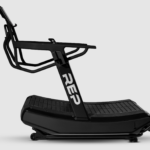
The REP Fitness STRIVE Curved Treadmill has been a long time coming. We first saw an early version at Home Gym Con 2025, returned to see it again at Home Gym Con 2026, and now the finished treadmill has officially been released.

After watching it develop over two years, the final product looks like much more than another manual treadmill. REP has combined a curved, self-powered running platform with adjustable deck geometry and a legitimate sled-training system. That combination makes the STRIVE especially appealing for HYROX, DEKA, CrossFit-style conditioning, brick workouts, and any session that alternates running with strength movements.
At $3,799.99, this is unquestionably a premium machine. It is also large, extremely heavy, and probably more treadmill than a casual walker needs. For the right athlete, however, the STRIVE can replace a manual treadmill, an indoor sled lane, and part of a conditioning station—all without requiring a wall outlet to operate.
Our quick take: The REP STRIVE is best suited to hybrid athletes and serious home-gym owners who want instant pace changes, sprint capability, and real sled training in one machine. Its price, 418-pound weight, and substantial space requirements are the primary drawbacks.
REP STRIVE Curved Treadmill Specifications
| Specification | REP STRIVE Curved Treadmill |
|---|---|
| Price at publication | $3,799.99 |
| Drive system | Manual/self-powered |
| Dimensions | 82 x 38.5 x 68 inches |
| Assembled weight | 418 pounds |
| Maximum user weight | 400 pounds |
| Slat-belt width | 17.6 inches |
| Deck positions | 0 degrees and 3 degrees |
| Sled resistance | 8 magnetic levels |
| Flat-deck resistance range | 25–550 pounds |
| Inclined-deck resistance range | 25–525 pounds |
| Console | 5 x 8-inch backlit display plus heads-down display |
| Connectivity | Bluetooth FTMS and ANT+ |
| Console power | Two D-cell batteries or included DC adapter |
| Warranty | 5-year frame, 2-year parts, 2-year belt |
From Home Gym Con Prototype to Finished Product
We saw the STRIVE Treadmill at Home Gym Con in both 2025 and 2026. That matters because this was not a product that appeared out of nowhere. REP continued refining the concept before bringing it to market.

Video from 2025 Home Gym Con
The central idea remained the same: create a treadmill that can handle natural running and serious sled work without forcing athletes to dedicate a long strip of their gym to turf. The released version has two deck positions, eight resistance levels, multiple sled-push hand positions, a clutch that disconnects the resistance during free running, and two displays.
Home Gym Con 2026
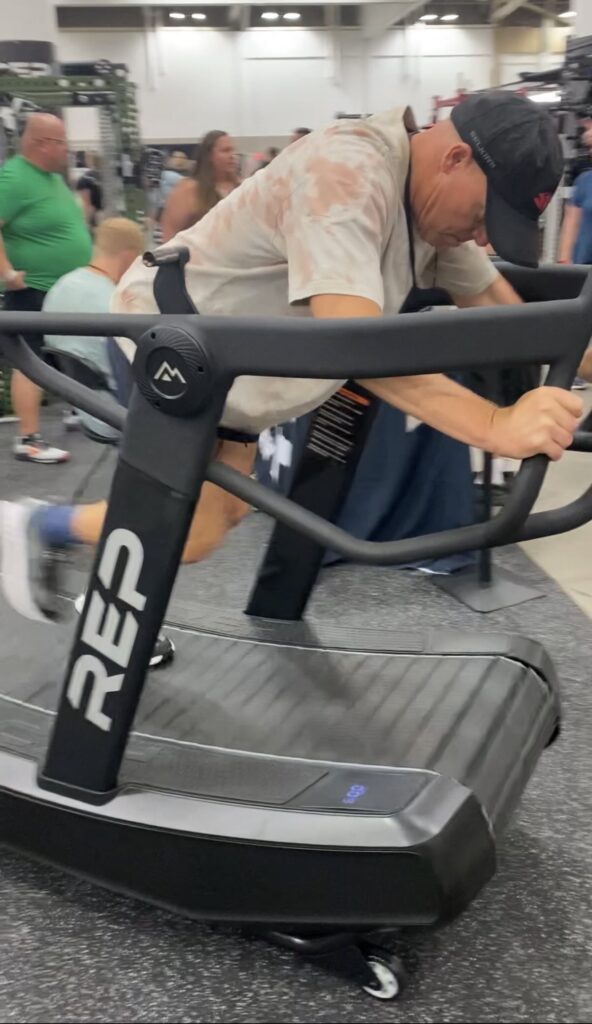
Our time with the treadmill at Home Gym Con gave us an early feel for its design and intended use. This article should therefore be considered a hands-on first review of the released model—not a claim that we have logged months of daily mileage on a production unit. We will update it if we get the opportunity to complete long-term testing.
Why a Mechanical Treadmill Makes Sense
The first major benefit is that the STRIVE is mechanical rather than motor driven. Your legs move the belt, so you do not select a pace and then try to keep up with the machine. Move faster and the belt accelerates. Back off and it slows with you.
That makes pace changes feel far more natural during intervals. There are no speed buttons to press, no delay while a motor accelerates, and no moment when the treadmill continues driving the belt after the work interval ends. For sprint-recover-sprint sessions, that responsiveness is a major advantage.
A motorless design also removes one of the most expensive and complicated components found on an electric treadmill. It would be too broad to say that a manual treadmill cannot break—the STRIVE still has bearings, a slatted belt, a clutch, resistance hardware, and electronic displays—but the absence of a drive motor generally means fewer powered components to service. The sealed bearings are pre-lubricated, and REP says routine lubrication is not required.
The treadmill itself needs no electricity. The console can operate on two D-cell batteries, which REP estimates will provide about 300 hours of use, or through the included power adapter.
It Moves at Your Pace—not a Forced Pace
This is the defining difference between the STRIVE and a traditional electric treadmill.
On a motorized treadmill, the machine establishes the speed. That can work well for steady Zone 2 running because it holds you to a precise pace. It is less natural when a workout calls for repeated transitions between running, sprinting, walking, and stopping for another movement.
On the STRIVE, pace is determined by where and how aggressively you run on the curved deck. Drive forward and the belt speeds up. Ease back and it slows down. Once you become comfortable with a curved treadmill, the response feels closer to running outdoors.
This also means the STRIVE will usually feel harder than a motorized treadmill at the same indicated pace because the athlete is responsible for moving the belt. New users should expect an adjustment period and avoid treating pace numbers as directly interchangeable with an electric treadmill or outdoor running.
Curved Platform vs. a Flat Treadmill
The curved running platform is not simply a styling decision. It is what allows the athlete to control the belt without a motor or speed buttons.
As you move toward the higher front portion of the curve, your foot lands farther ahead of the belt’s lowest point. Gravity and your backward drive apply more force to the slats, causing the belt to accelerate. When you shorten your stride and drift back toward the center, the belt naturally slows. This creates the responsive feeling that makes curved treadmills so effective for sprinting and interval training.
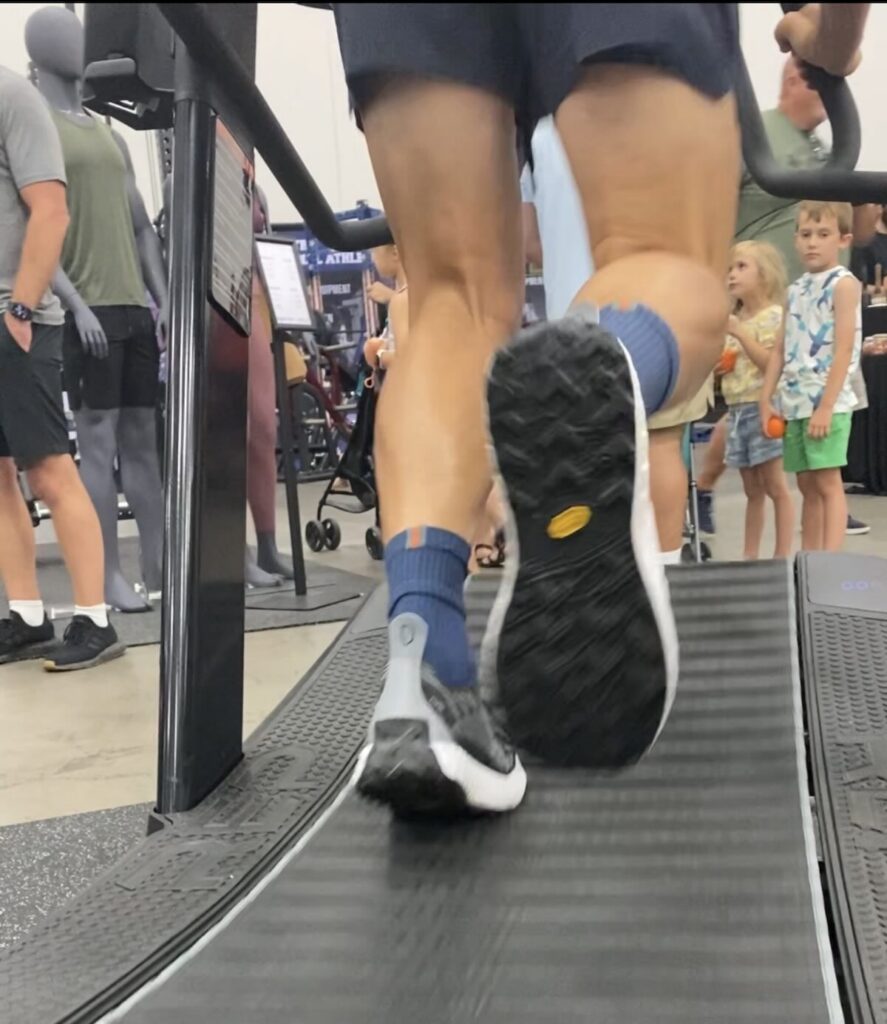
A traditional flat motorized treadmill works differently. Its deck remains level—or changes through a powered incline system—while a motor pulls the belt at the speed selected on the console. You must match the treadmill’s pace until you press a button and wait for it to accelerate or decelerate. That can be valuable for steady running because the machine holds a consistent speed, but it is less natural during short sprints and fast workout transitions.
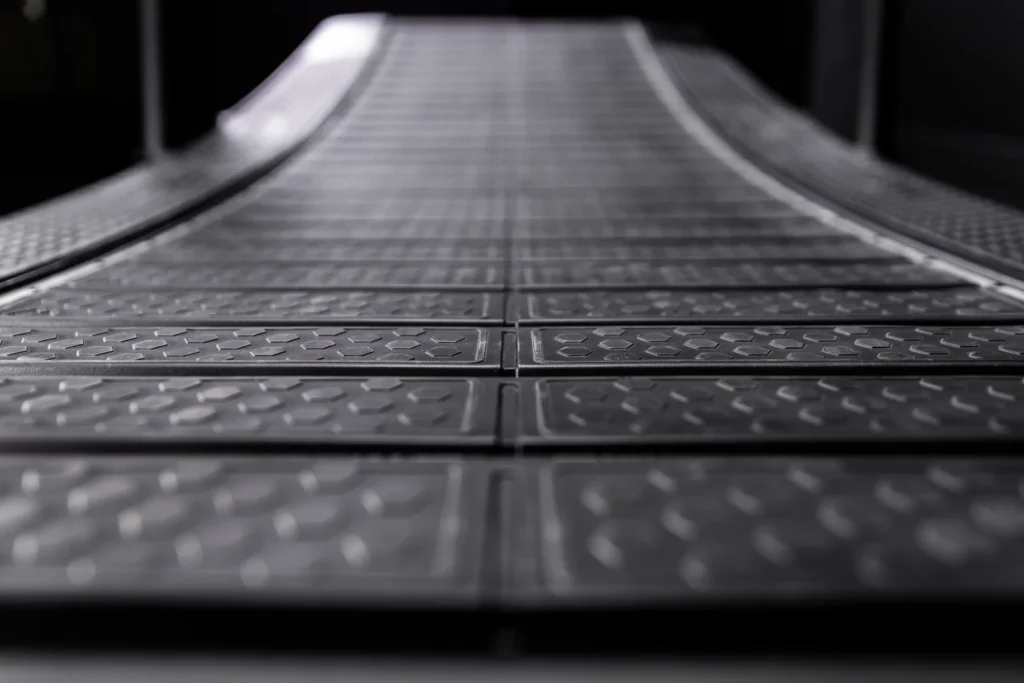
There are also inexpensive flat manual treadmills, but those should not be confused with the STRIVE. A basic flat manual belt can be difficult to start and may require the user to hold the rails while walking. The STRIVE’s curved shape uses the athlete’s position, body weight, and stride to keep the slatted belt moving, making it suitable for walking, jogging, and full-speed running.
The curve does require an adjustment period. Running too close to the front can cause the belt to accelerate more quickly than expected, while staying too far back makes it harder to maintain speed. Once you learn where your body should be positioned, controlling pace becomes intuitive.
REP takes the curved-platform concept a step further by allowing the entire deck to be set at either 0 degrees or 3 degrees. This does not flatten the curved belt itself. Instead, it changes the angle of the complete running platform. The 0-degree position gives the curve a more controlled, endurance-oriented feel, while the 3-degree position makes the belt more responsive for sprints, high-intensity intervals, and sled work.
| Feature | STRIVE Curved Platform | Flat Motorized Platform | Basic Flat Manual Platform |
|---|---|---|---|
| What moves the belt? | The athlete’s stride and position | Electric motor | The athlete, primarily by pushing backward |
| Pace changes | Immediate and natural | Controlled with buttons and limited by motor response | Athlete controlled, but usually less fluid |
| Best suited for | Sprints, intervals, running, and sled work | Steady running, walking, and powered incline work | Light walking |
| Running feel | Responsive and similar to outdoor acceleration | Belt establishes the pace | Often difficult to start and maintain |
| Learning curve | Requires practice finding the correct position | Familiar to most treadmill users | Often requires holding the rails |
| Electricity required | No | Yes | No |
Why the STRIVE Is Ideal for HYROX and DEKA Training
HYROX and DEKA workouts are built around transitions. You run, move into a strength or functional station, and then return to running with fatigue already in your legs. A curved manual treadmill fits that format extremely well.
You can accelerate immediately when a running interval starts and step off without waiting for a motorized belt to slow down. More importantly, the STRIVE adds sled pushes and pulls to the same footprint. HYROX athletes can practice the difficult transition from running into a heavy sled push and then back into running without owning a turf lane or loading and unloading plates.
The eight sled settings offer substantially more than token resistance. With the deck flat, REP lists levels of 25, 50, 75, 100, 150, 275, 445, and 550 pounds. With the deck raised, the listed levels are 25, 50, 75, 100, 125, 250, 400, and 525 pounds.
Those numbers should be treated as REP’s estimated sled-equivalent resistance rather than the literal plate load on a conventional sled. Turf type, sled runners, surface friction, and momentum make a direct one-to-one comparison difficult. Even so, the range is broad enough for light conditioning, heavy pushes, and progressive sled sessions.
For sled pulls or heavier backward work, REP sells treadmill straps and a belt squat belt separately. The belt can travel backward, opening the door to reverse walking, backward drags, and knee-focused training.
A Strong Choice for Brick and Mixed-Modality Workouts
The STRIVE also makes sense for brick workouts—sessions that combine two or more disciplines or training modes with little rest between them.
Triathletes typically use the term for bike-to-run training, but the same principle applies to hybrid conditioning. Place the STRIVE near an air bike, rower, SkiErg, rack, or functional trainer and you can build demanding workouts without touching the treadmill controls between rounds.
Sample workouts could include:
- 10 minutes on the bike followed immediately by a 1-kilometer run
- 500 meters of rowing followed by a 400-meter run
- Heavy sled push, 20 walking lunges, and an 800-meter run
- 10 kettlebell swings, 10 burpees, and a 200-meter sprint
- Alternating easy running and short, high-resistance sled pushes
Because the belt responds directly to the athlete, the treadmill works equally well for structured intervals and less predictable circuits.
The Sled Mode Is the Standout Feature
Manual curved treadmills are not new. What separates the STRIVE is that sled training appears to be part of the original design rather than an improvised secondary use.

A side lever controls the clutch and eight resistance settings. In Free Run mode, the clutch completely disengages the sled resistance so the treadmill does not carry unnecessary magnetic drag. For sled work, the resistance can be increased and the athlete can use several high, low, and shoulder-supported handle positions.
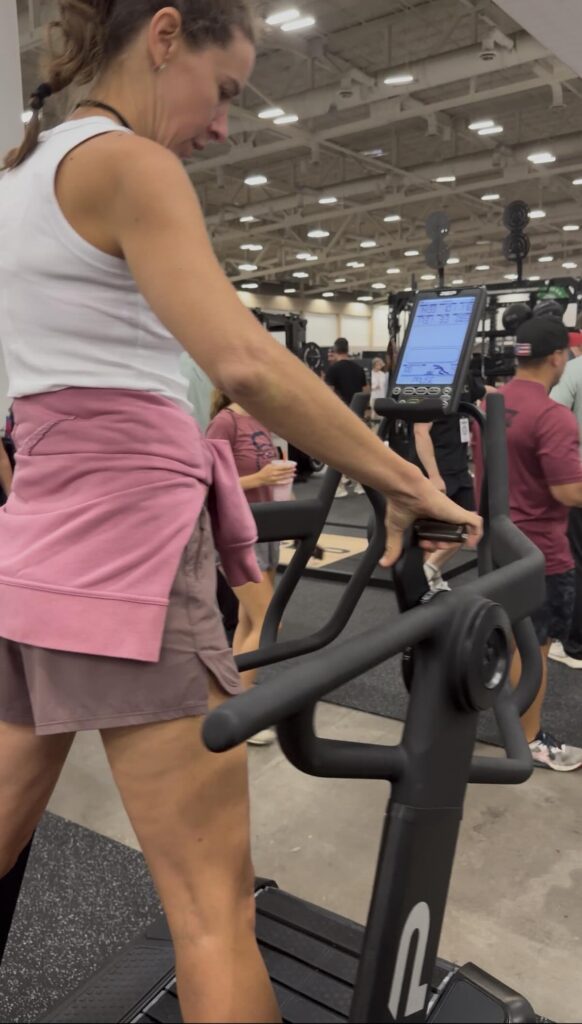

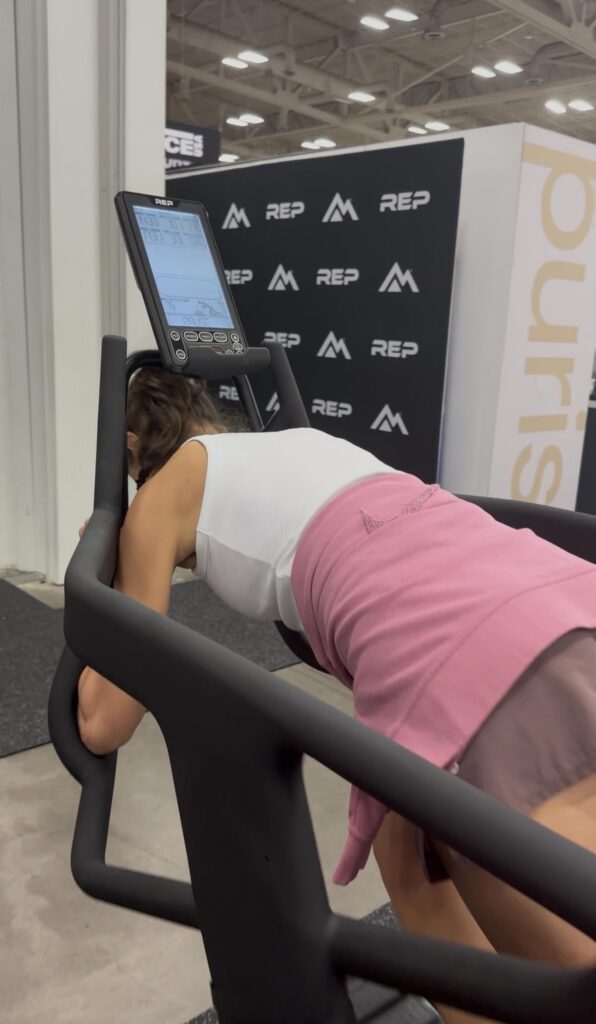
REP also placed a small display near the front of the deck. When you drop into a low sled-push position, you can see distance without lifting your head to find the main console. That is a small feature, but it shows that the machine was designed by people who understood how it would actually be used.
REP advises stopping the belt before moving between Free Run and sled settings. If the belt is still moving during the transition, a brake automatically engages.
Adjustable Deck: Work Mode and Sprint Mode
Most curved treadmills lock the user into one deck geometry. REP gives the STRIVE a flat position and a 3-degree raised position, adjusted with gas-assisted shocks.
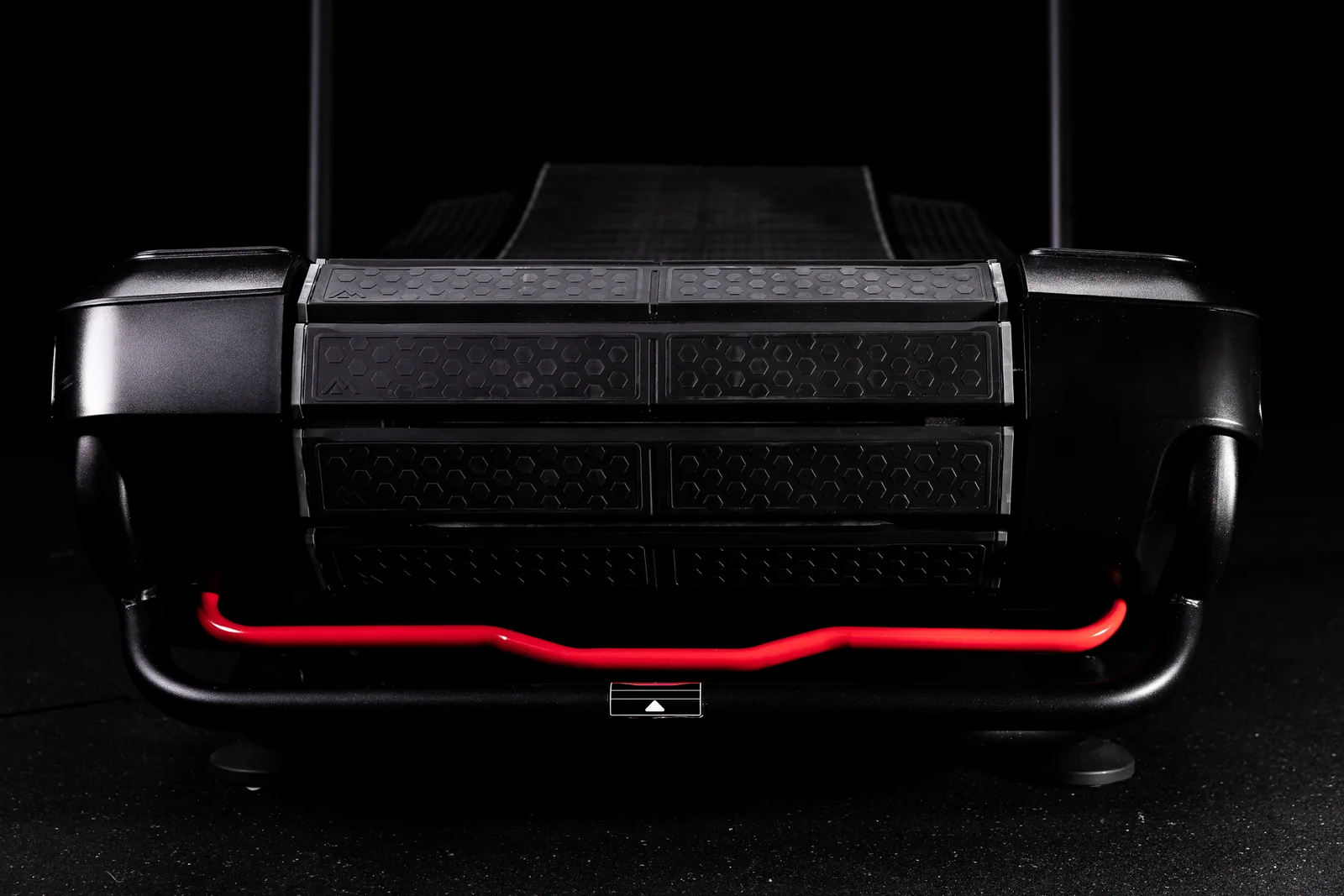
The flat setting is designed to feel more controlled and support upright, endurance-oriented running. The inclined setting makes the belt more responsive for sprinting and high-intensity work. Changing the angle also alters the listed resistance at the upper sled levels.
This is a meaningful addition because endurance running and aggressive sprinting do not necessarily feel best on the same curve. The ability to change the deck gives the STRIVE a better chance of serving as both a running treadmill and a hybrid-conditioning tool.
Console and Connectivity
The main backlit console reports time, distance, calories, speed, pace, and heart rate when paired with a compatible ANT+ or Bluetooth monitor. It can also display the deck position and estimated sled resistance.
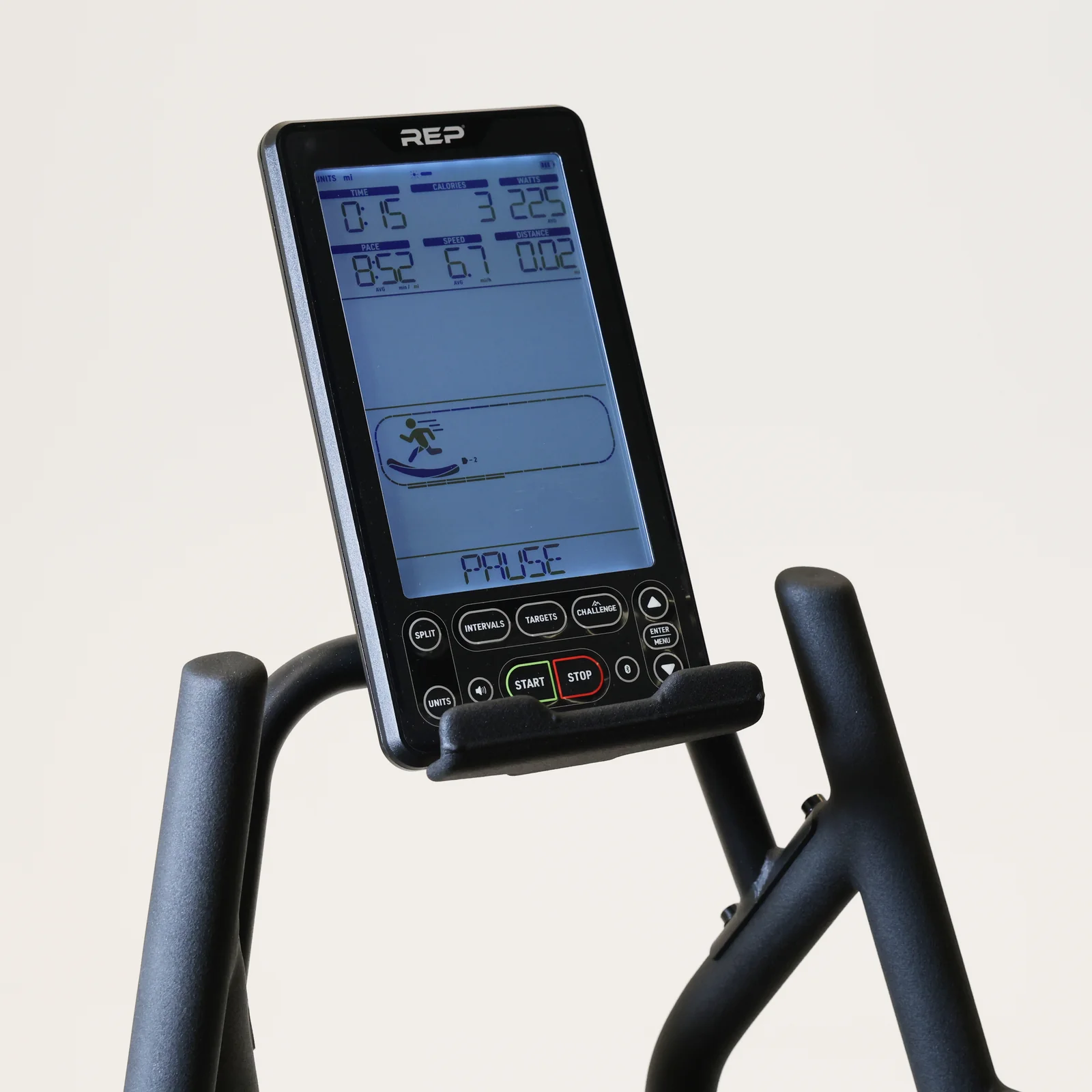
Bluetooth FTMS compatibility allows the console to work with supported third-party apps such as Zwift, Kinomap, GymTrakr, and iConsole. Apple Watch, Apple Health, and Garmin devices do not connect directly to the console; workout data must pass through a compatible FTMS app.
This is a training-focused console rather than an entertainment system. There is no oversized touchscreen, subscription platform, or built-in streaming experience. For athletes who simply want clear metrics and reliable connectivity, that may be a benefit. Anyone looking for coached studio classes and a cinematic display will likely prefer a high-end motorized treadmill.
Size, Delivery, and Assembly
This is where prospective buyers need to pay attention. The STRIVE weighs 418 pounds and arrives by curbside freight in a package weighing approximately 528 pounds. It is not a machine you casually carry downstairs after delivery.
Fully assembled, it measures 82 inches long, 38.5 inches wide, and 68 inches tall. REP states that it will not fit through a standard doorway once assembled, so it should be built in its final location. Assembly is expected to take one to two hours and should be completed with another person.
Although transport wheels allow the treadmill to be tipped and repositioned, REP describes the lift-and-pivot weight as feeling like approximately 175 pounds. It is movable, but not truly portable.
Buyers also need more room than the machine’s physical footprint. REP recommends 79 inches of open space behind it and 24 inches at the front and on each side. The recommended minimum ceiling height is 96 inches, while the running surface sits 17.7 inches above the floor.
What We Like
- The belt responds instantly to the athlete’s pace.
- No drive motor or electrical outlet is required for operation.
- The clutch fully disconnects sled resistance for unrestricted running.
- Eight resistance levels provide a wide range for sled training.
- Flat and 3-degree deck settings support different running styles.
- The heads-down display is genuinely useful during sled pushes.
- It brings running and sled work into one footprint.
- Backward belt travel expands knee-health and reverse-training options.
- FTMS and ANT+ connectivity are included.
- The 400-pound user capacity and heavy frame suggest commercial intent.
What Could Be Better
- At $3,799.99, it is a major investment for a home gym.
- The 418-pound assembled weight complicates delivery and relocation.
- It cannot pass through most standard doorways after assembly.
- A 17.6-inch belt may feel narrow to runners accustomed to wide motorized decks.
- Sled straps and the belt required for some pull variations cost extra.
- The two deck angles provide useful versatility but do not replace the broad incline range of an electric incline treadmill.
- It is less suited to users who want the machine to enforce a steady pace.
- Long-term durability and service experience still need to be established now that the production model is in customers’ hands.
REP STRIVE vs. a Traditional Motorized Treadmill
| Category | REP STRIVE | Motorized Treadmill |
|---|---|---|
| Pace control | Athlete controlled | Machine controlled |
| Sprint transitions | Immediate | Limited by motor acceleration |
| Sled training | Built in | Generally unavailable |
| Electricity | Not needed for operation | Required |
| Steady pace enforcement | Requires athlete control | Excellent |
| Incline range | 0 or 3 degrees | Often multiple powered levels |
| Entertainment | Basic training display | Often includes a large screen/apps |
| Best use | Intervals, hybrid racing, sled work | Walking, steady running, incline work |
The STRIVE is not automatically better than an electric treadmill. It is better for a particular style of training. If your priority is long, controlled walks at a fixed speed or steep automated incline sessions, a motorized treadmill may be the smarter choice. If you train with sprints, circuits, fast transitions, and sled work, the STRIVE is much more compelling.
Who Should Buy the REP STRIVE?
The STRIVE is best for:
- HYROX and DEKA competitors
- Hybrid athletes
- CrossFit and functional-fitness athletes
- Runners who prefer self-selected pacing
- Triathletes performing indoor bike-to-run bricks
- Home gyms without room for a turf sled lane
- Coaches and commercial facilities serving multiple training styles
- Athletes who want to combine forward running, backward walking, and sled work
It may not be the best fit for:
- Casual walkers
- Anyone who needs the treadmill to hold an exact pace
- Buyers with a small budget or tight room dimensions
- Users who want a folding treadmill
- People with balance concerns who would benefit from a predictable motorized belt
- Runners primarily interested in steep automated incline or decline training
Final Verdict
The REP Fitness STRIVE Curved Treadmill is one of the more interesting cardio products REP has released because it solves a real home-gym problem. Most people do not have room for both a full-size treadmill and a usable turf lane. The STRIVE provides natural, athlete-controlled running and heavy sled-style resistance in a single station.
Its greatest strength is not simply that it is manual. It is the way the entire package works together: instant pace changes, a disengaging clutch, two deck positions, eight sled settings, multiple push positions, backward movement, and a display that remains visible during sled work.
The $3,799.99 price and 418-pound frame will narrow the audience. This is not the treadmill we would recommend to someone who only wants to walk while watching television. But for HYROX, DEKA, brick workouts, and mixed-modality conditioning, the STRIVE offers a combination that few home cardio machines can match.
After seeing the treadmill at Home Gym Con in 2025, watching its continued development at Home Gym Con 2026, and now seeing the final production specifications, our first impression is positive. REP took its time with the STRIVE, and the released version looks like a thoughtfully designed conditioning platform rather than another copy of an existing curved treadmill.
GearMashers preliminary rating: 4.5 out of 5
We will revisit that score after extended testing of a production unit, particularly to evaluate long-term belt feel, resistance consistency, console accuracy, assembly, and durability.
Frequently Asked Questions
Does the REP STRIVE Treadmill require electricity?
No. The belt is powered by the user. The console can run on two included D-cell batteries or the included DC adapter.
Can the STRIVE be used for sled pushes?
Yes. It has eight magnetic resistance levels and dedicated high, low, and shoulder-supported handle positions. REP lists a maximum estimated sled resistance of 550 pounds with the deck flat and 525 pounds with the deck inclined.
Is it good for HYROX training?
Yes. It is particularly well suited to HYROX-style sessions because athletes can move quickly between running and resisted sled work without needing a turf lane.
Can you walk backward on it?
Yes. The belt supports backward movement. REP recommends its optional treadmill straps and belt squat belt for heavier reverse sled drags.
Is a manual treadmill easier to maintain than an electric treadmill?
It eliminates the drive motor found in an electric treadmill and does not require routine bearing lubrication. However, it still contains moving parts, a clutch, resistance components, and electronic displays that may eventually require service.
Can it fit through a standard doorway?
Not when fully assembled. REP recommends assembling the treadmill with another person in its final location.
What is the warranty?
REP currently lists a five-year frame warranty, a two-year parts warranty, and a two-year belt warranty.