



REP Fitness Spotter Arms 2.0 Review: Safer, Smarter, and More Versatile
Spotter arms are one of those rack attachments you hope you never truly need, but they can become the most important pieces of equipment in your gym when a lift goes wrong. Their job is simple: catch the bar during a failed squat, bench press, or other barbell movement. However, that does not mean every set of spotter arms is equally easy to install, position, or live with.
GEARMASHERS REVIEW SUMMARY
REP Fitness Spotter Arms 2.0
Best for
PR-5000 owners who squat or bench outside the rack and want safeties that work around REP cable systems
Standout feature
Low-profile swing-in C-cup mount that secures without a separate locking pin
What I like
Easier installation, more room around J-cups and cable trolleys, full-length TPU bar protection, and a choice of standard or short arms.
What to consider
PR-5000 upright compatibility only. The standard arms are heavy, while the short arms have a smaller catch zone. Freestanding racks may need front foot extensions or anchoring.
Price
$239.99
Quick verdict
A refined upgrade for compatible REP racks. I would choose the standard length for the greater catch area; the short version makes sense when space or a particular exercise setup calls for it.
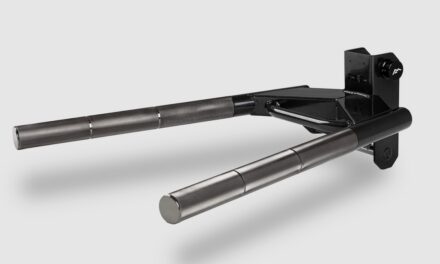
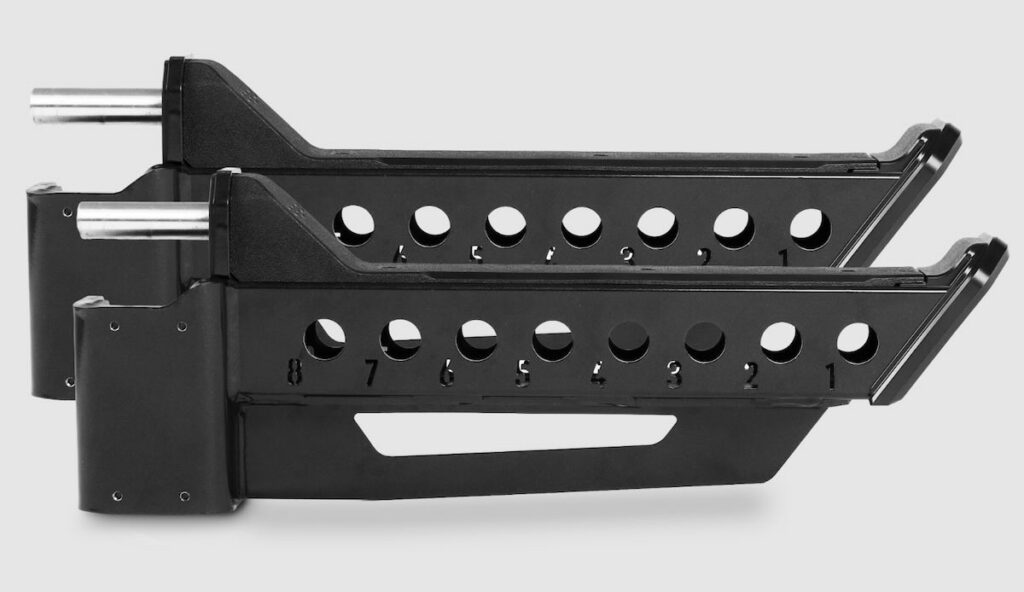
The REP Fitness Spotter Arms 2.0 take a familiar safety attachment and improve it in several meaningful ways. REP lowered the profile, introduced a new swing-in C-cup mounting system, upgraded the protective liners, and added a short version for compact racks and specialized exercises. The result is a cleaner and more versatile design that works particularly well with REP’s increasingly complex rack ecosystem.
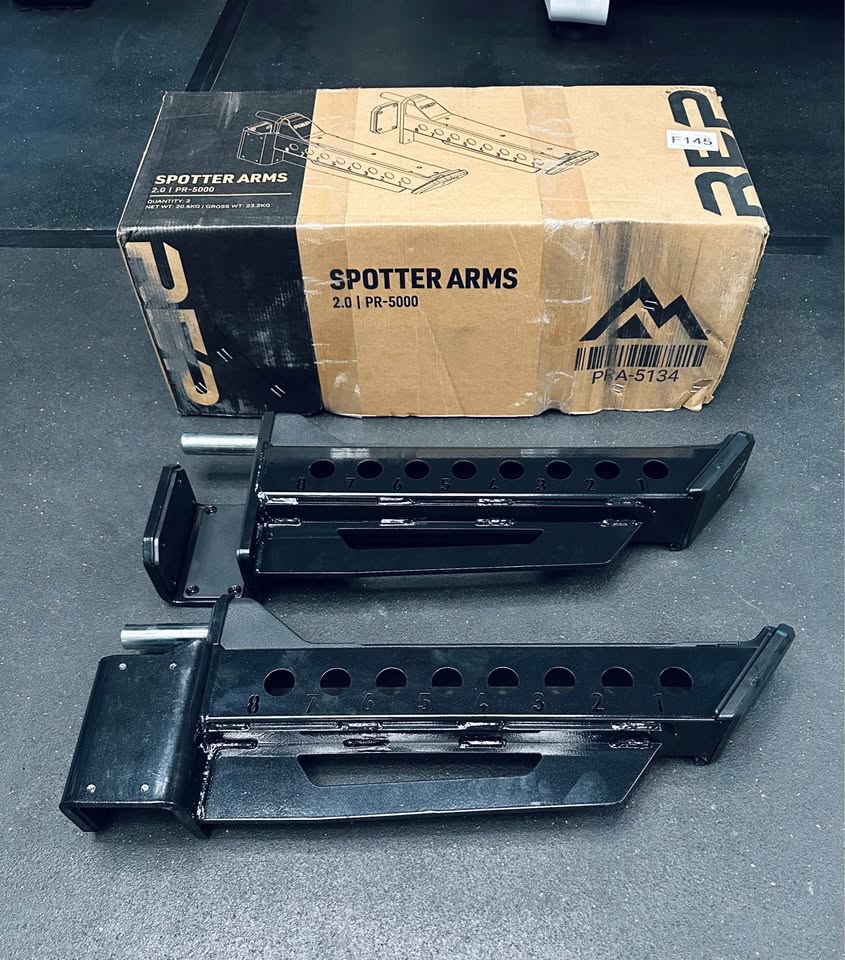

At $239.99 per pair at the time of this review, these are not inexpensive spotter arms. They are also currently designed specifically for racks using PR-5000 uprights, so compatibility must be considered before ordering. For the right rack owner, however, the improved mounting system, 1,000-pound capacity, and choice of two lengths make the Spotter Arms 2.0 a substantial upgrade over the original design.

REP Fitness Spotter Arms 2.0 Specifications
| Specification | Standard Length | Short |
|---|---|---|
| Overall length | 24.90 inches | 15.96 inches |
| Installed length from upright | 21.35 inches | 13.46 inches |
| Usable landing zone | 15.07 inches | 7.21 inches |
| Width | 3.80 inches | 3.80 inches |
| Height | 8.86 inches | 8.86 inches |
| Weight per arm | 22.71 pounds | 16.84 pounds |
| Construction | 11-gauge steel | 11-gauge steel |
| Protective liner | TPU | TPU |
| Side holes | 1.06 inches with 1.97-inch spacing | 1.06 inches with 1.97-inch spacing |
| Tested capacity | 1,000 pounds | 1,000 pounds |
| Rack compatibility | PR-5000 configurations | PR-5000 configurations |
What Changed With the 2.0 Design?
The biggest improvement is the new swing-in C-cup attachment. The original style did its job, but the revised mounting system is smoother to install and takes up less room on the upright. Rather than using an additional hitch pin to stop the arm from rotating, the C-cup wraps around the upright and secures the attachment without a second pin.
That lower-profile design matters more than it might seem. Modern power racks can become crowded quickly, especially when you add J-cups, cable trolleys, leg rollers, storage attachments, and other accessories. By using less vertical space, the Spotter Arms 2.0 give you more flexibility when positioning everything on the same upright.


REP also updated the appearance and contact points. Full-length TPU liners protect the barbell and help prevent the knurling from grinding directly against steel. The front face has added protection, and the end incorporates a raised ramp to help keep the bar from rolling off. The metallic black powder coat and updated branding make these look more refined than many basic spotter arms.
Standard vs. Short Spotter Arms
REP offers the Spotter Arms 2.0 in two sizes, and choosing the correct version is important.
Standard-length version
The standard model is the traditional choice for squatting and bench pressing outside a rack. It extends 21.35 inches from the face of the upright and provides a 15.07-inch usable landing zone. That extra coverage gives you more room if your squat travels forward or backward during a failed rep.
If you want one pair to handle the widest range of conventional lifting situations, the standard version is the safer and more versatile choice. REP also shortened this version enough to fit inside a rack with its Smith Machine attachment installed in a 30- or 41-inch rack configuration.
Short version
The short version extends only 13.46 inches from the upright and offers a 7.21-inch landing zone. It is easier to handle, takes up less space, and is especially useful on wall-mounted or compact four-post configurations.
The short arms can also function as oversized or extended J-cups. This can be useful for incline pressing when a bench cannot slide far enough back toward the uprights. That is a clever secondary use, but the shorter landing zone gives you less margin for error during a failed squat. I would consider the short version a specialized space-saving option rather than an automatic replacement for full-size spotter arms.
Installation and Adjustability
The arms arrive fully assembled and do not require tools. To install one, align the heat-treated pin with the desired one-inch rack hole and swing the C-cup around the upright. The new design feels more deliberate than a loose-fitting attachment and eliminates the separate locking pin found on many competing spotter arms.
There is technically a left and right arm when installing them on the front uprights of an Ares 2.0 setup. In that configuration, they should swing inward from inside the rack so the mounting motion does not interfere with the cables. In most other configurations, the arms are not side-specific.
The standard arms weigh 22.71 pounds each, so they are still substantial pieces of steel. They are manageable, but frequently moving them from a low bench position to a higher squat position takes more effort than repositioning a strap safety. The short version drops the individual weight to 16.84 pounds and is noticeably easier to store and move.
Safety and Stability
REP drop-tested the Spotter Arms 2.0 for dynamic loads up to 1,000 pounds. That is far beyond what most home-gym lifters will ever place on a bar, but capacity alone does not make every rack configuration stable.
When these arms are mounted outside a freestanding four-post PR-5000 rack, REP recommends using front foot extensions at a minimum. Flat-foot racks such as the Apollo or Omni do not require those extensions. A properly secured wall-mounted configuration also does not necessarily need front feet, although the installation must be anchored correctly and the uprights must sit securely on the floor.
This is an important point: the spotter arms may be rated for 1,000 pounds, but the entire rack must be able to resist the forward leverage created when a loaded bar lands outside the front uprights. If your rack is light, unbolted, or not properly stabilized, adding heavy-duty spotter arms does not automatically make the setup safe.
Barbell and Rack Protection
The full-length TPU liners are one of the best practical upgrades. They give the bar a protected landing surface and reduce metal-on-metal damage to both the barbell and spotter arms. The liner on the raised front edge is also helpful because that is an area where a bar can make contact when being rolled or repositioned.
As with any safety attachment, the liners should be inspected periodically. Chalk, sweat, and repeated bar drops will eventually leave marks and can cause wear. After a significant drop, check that the mounting pin remains fully seated and that the C-cup still wraps securely around the upright.
More Than a Safety Attachment
The one-inch holes along the sides increase the usefulness of the arms. They allow a PR-5000 Leg Roller 2.0 to be installed directly on the attachment, opening the door to additional exercise setups. Depending on the direction of force, REP recommends reversing the arms when necessary so the exercise does not encourage them to rotate away from the upright.
REP also shows its Utility Bench mounted across the standard arms. These alternative uses make the Spotter Arms 2.0 more than passive safety equipment, although I would still buy them primarily for barbell protection rather than treating the secondary exercises as the main selling point.
Compatibility
The Spotter Arms 2.0 are intended for rack configurations that use REP PR-5000 uprights. Compatible setups include many PR-5000, Ares 2.0, Athena, Apollo, Omni, Summit, and wall-mounted configurations.
They are also designed to work around REP’s Ares 1.0, Ares 2.0, and Athena cable systems. That compatibility is one of the strongest reasons for a REP rack owner to choose these instead of a generic 3-by-3-inch attachment. Small differences in pin diameter, upright dimensions, hole placement, and protective plastic can affect how third-party attachments fit—even when the published rack measurements appear similar.
REP currently does not offer this updated 2.0 design for the PR-4000. Owners of that rack should not assume the PR-5000 model will fit.
What I Like
- 1,000-pound dynamic load rating: More capacity than nearly any home-gym lifter will require.
- Lower-profile mounting system: Leaves additional upright space for J-cups, cable trolleys, and other attachments.
- No secondary locking pin: The C-cup secures the arm while making installation faster and less cluttered.
- Standard and short options: Buyers can prioritize maximum coverage or compact-rack versatility.
- Improved protection: Full-length TPU liners and a protected front ramp reduce metal-on-metal contact.
- Cable-system compatibility: Designed to work with popular Ares and Athena configurations.
- Side holes: Add compatibility with accessories such as the REP Leg Roller 2.0.
- Lifetime warranty on structural welds: Helpful reassurance for a safety-focused rack attachment.
What Could Be Better
- PR-5000 only: There is no Spotter Arms 2.0 version for the PR-4000 at this time.
- Price: At $239.99, they cost considerably more than many generic spotter arms.
- Standard arms remain heavy: At 22.71 pounds each, moving and storing them still requires some effort.
- Short version has a limited catch zone: The 7.21-inch usable surface may be too short for lifters who move significantly during a failed squat.
- Rack stability still matters: Four-post racks may require front foot extensions or floor anchoring for safe external use.
REP Spotter Arms 2.0 vs. Safety Straps
Spotter arms and safety straps solve the same basic problem differently. Spotter arms provide a rigid surface and are especially convenient when lifting outside a half rack. They can also be used to stage a bar or support certain accessories. The tradeoff is their weight and the harshness of a bar landing on a solid surface.
Safety straps are lighter to reposition and provide a softer catch that is generally easier on the bar. They also allow each end to be mounted at a different height, which can help direct a failed bar away from the lifter. However, straps require two attachment points per side and normally remain inside the rack.
If you regularly squat or bench outside your rack, spotter arms are usually the practical choice. If most of your lifting takes place inside a full power rack, straps may be more convenient. Many serious home gyms will benefit from having both.
Who Should Buy the REP Spotter Arms 2.0?
These are an excellent fit for:
- PR-5000 owners who squat or bench outside the rack;
- lifters using an Apollo, Omni, Ares, Athena, or compatible wall-mounted setup;
- anyone who wants a low-profile attachment that does not crowd cable trolleys or J-cups;
- compact-rack owners who can take advantage of the short version; and
- lifters who value a precise ecosystem fit over choosing the least expensive generic attachment.
They make less sense for PR-4000 owners, lifters whose racks cannot be properly stabilized, or anyone who does all barbell work inside a full rack with safety straps already installed.
Final Verdict
The REP Fitness Spotter Arms 2.0 improve on the original design without overcomplicating a basic safety attachment. The swing-in C-cup is easier to work with, the reduced height makes better use of valuable upright space, and the upgraded liners protect both the bar and the attachment. Offering short and standard versions also allows REP to serve both traditional half racks and increasingly popular compact or wall-mounted systems.
The standard pair is the best all-around choice because its longer landing zone provides greater confidence during squats and bench presses. The short pair is more specialized, but it is a smart solution for limited space, incline pressing, and racks where a full-length arm would be cumbersome.
The biggest limitations are the premium price and PR-5000-only compatibility. If you already own a compatible REP rack, though, the fit, finish, thoughtful mounting system, and tested capacity make these some of the most refined conventional spotter arms available.
GearMashers rating: 9.2/10
Best for: PR-5000 owners who want heavy-duty safeties with better rack and cable-system integration.
Buy the REP Fitness Spotter Arms 2.0: Check the current price at REP Fitness
Frequently Asked Questions
How much weight can the REP Spotter Arms 2.0 hold?
REP states that the arms were drop-tested for dynamic loads up to 1,000 pounds.
Do they require a locking pin?
No. The swing-in C-cup design wraps around the upright and does not require an additional pin to prevent rotation.
Do the Spotter Arms 2.0 fit the PR-4000?
No. The current version is designed for rack configurations using PR-5000 uprights. REP says it does not currently plan to bring the 2.0 update to the PR-4000 version.
Should I buy the short or standard version?
Choose the standard version for the largest catch area and the widest range of squatting and bench-pressing applications. Choose the short version for compact or wall-mounted racks, easier handling, or use as an extended J-cup for incline pressing.
Does a rack need to be bolted down?
That depends on the rack. REP recommends at least front foot extensions when using the arms outside a freestanding four-post PR-5000. Flat-foot and properly anchored wall-mounted systems may not require them. Bolting down a compatible rack provides the greatest stability.