



REP Fitness Ares 2.0 Review: Cost, Compatibility and Comparisons
REP Fitness Ares 2.0 Review: A Complete Cable Gym Built Into a Power Rack
Home gyms force you to make decisions about space. A full power rack, functional trainer, lat pulldown, and low-row machine can easily consume an entire garage bay. The REP Fitness Ares 2.0 combines those functions by integrating a selectorized cable system directly into a compatible REP PR-4000 or PR-5000 power rack.
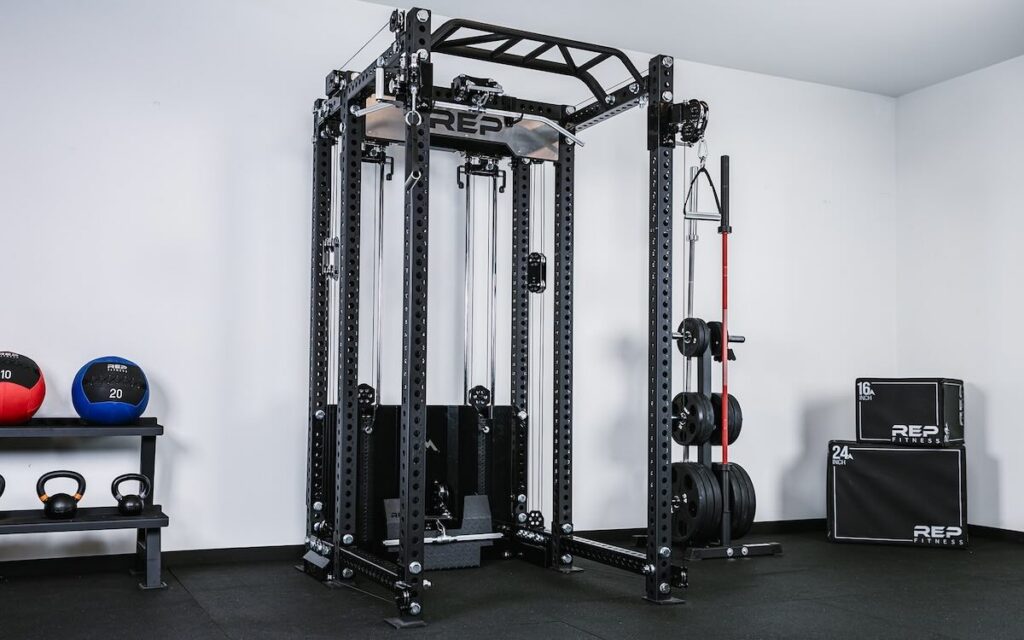
The original Ares helped define this category, but the second generation is more than a minor update. REP rotated and pushed the dual stacks farther back, added a more comfortable seated-row position, changed the cable routing, improved bench clearance, moved the resting trolley position to the bottom of the uprights, and extended the front pulleys outward for a better functional-training range of motion.
The result is one of the most complete rack-integrated cable systems available. It is also a major investment that locks the buyer into REP’s rack geometry. That ecosystem question becomes especially important when comparing REP’s 75-by-75-millimeter uprights with Rogue’s true 3-by-3-inch Monster uprights or Eleiko’s smaller 70-by-70-millimeter Prestera system.
REP Ares 2.0 Quick Specifications
| Specification | Ares 2.0 |
|---|---|
| Compatible racks | REP PR-4000 and current-generation PR-5000 |
| Standard weight stacks | Dual 260-pound stacks |
| Optional upgraded stacks | Dual 310-pound stacks |
| Functional-trainer ratio | 2:1 |
| Felt resistance | 260-pound stack feels like approximately 130 pounds per side |
| Trolley and cable rating | 450 pounds |
| System width | 57.6 inches, including cable components |
| Maximum added width | 5.2 inches |
| Added depth | 6 inches |
| Rack heights | 80 or 93 inches |
| Cable travel | 71.3 inches on 80-inch rack; 94.9 inches on 93-inch rack |
| Standard attachment price | Starting at $2,999.99 at time of review |
| Complete wall-mounted system | Starting at $4,039.93 at time of review |
What Is the Ares 2.0?
The Ares 2.0 is a dual-stack functional trainer, lat pulldown, and seated-row system that attaches to a REP power rack. It preserves the rack’s primary functions, allowing you to squat, bench, use safeties, perform pull-ups, and attach compatible rack accessories while adding a large cable-exercise library.

Functional Trainer
For lat pulldowns and seated rows, the two sides can be connected so both stacks contribute to the movement. They can also be used independently for iso-lateral pulling exercises.
What REP Improved Over the Original Ares
The Ares 2.0 solves several practical limitations from the first generation.
More usable space inside the rack
REP rotated the stacks 90 degrees and moved them farther toward the rear. This gives a bench more room inside the rack and improves clearance for incline pressing, flat benching, and Safety Squat Bar work. Cutouts in the side panels help center compatible REP benches farther back.
Better seated-row position
The original system’s very low row point could create an awkward pulling angle. The Ares 2.0 raises this position to approximately 13 inches, making seated rows more comfortable whether you sit on a bench or on the floor.
Improved trolley storage and adjustment range
The front trolleys now rest near the bottom of the uprights rather than occupying valuable holes near the top. This preserves more upper attachment positions for J-cups and other rack accessories, particularly on the shorter 80-inch rack.
Wider pulley positioning
The swivel pulleys sit farther outside the uprights. This improves the path for cable flyes, lateral raises, and crossover-style movements and makes the Ares feel more like a traditional standalone functional trainer.
Smoother cable system
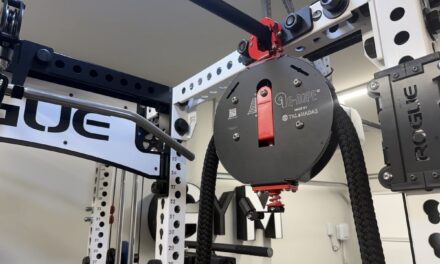
REP uses aluminum pulleys, custom cable retainers, and a thinner cable coating. The trolleys have protective liners, a knurled adjustment handle, and an oversized pop-pin so they can be repositioned with one hand.
The 75 mm REP Rack vs. a True 3-by-3-Inch Rogue Rack
One of the most overlooked differences between premium racks is that “3-by-3” does not always mean exactly the same thing.
The REP PR-5000 is commonly described as a 3-by-3-inch rack, but its uprights are manufactured to the metric standard of 75 mm by 75 mm. Converted to inches, 75 mm equals approximately 2.953 inches.
The Rogue Monster Series uses true 3-by-3-inch tubing, or 76.2 mm by 76.2 mm. The difference is only about 1.2 mm on each side of an upright, but tight-fitting attachments can expose that difference quickly.
The Eleiko Prestera system is smaller still at 70 mm by 70 mm, or approximately 2.76 by 2.76 inches.
| Rack ecosystem | Upright size | Approximate inch equivalent |
|---|---|---|
| REP PR-5000 | 75 × 75 mm | 2.953 × 2.953 inches |
| Rogue Monster | 3 × 3 inches | 76.2 × 76.2 mm |
| Eleiko Prestera | 70 × 70 mm | 2.76 × 2.76 inches |
These differences affect more than attachment tightness. Rack width, crossmember length, hole alignment, hardware, powder-coat thickness, and cable routing are all engineered around a particular geometry.
Why the REP Rack Feels Roughly Two Inches Narrower Than Rogue Monster
A REP rack has an outside upright width of roughly 47 inches, while a Rogue Monster rack is approximately 49 inches wide across the outside of its uprights. In practical terms, the REP platform is about two inches narrower.
That comparison refers to the rack frame, not necessarily the complete functional-trainer footprint. The Ares 2.0 reaches 57.6 inches across when its external cable components are included. Rogue also lists wider overall FM-6 measurements depending on pulley configuration and whether weight storage is installed.
The narrower REP frame has practical advantages. It provides slightly more clearance between a standard 86.5-inch barbell’s sleeves and the uprights or J-cups, reducing the chance of clipping the rack while reracking a squat or bench press. A wider rack can feel more spacious between the uprights, but it leaves less lateral room on the bar sleeves.
Neither geometry is automatically better. It is a design choice that becomes important when mixing attachments across brands.
Why the REP Smith Machine Does Not Fit a Rogue Monster Rack
The REP Smith Machine attachment is designed for compatible PR-5000 configurations. It should not be treated as a universal attachment simply because both REP and Rogue market their uprights as 3-by-3 inches with one-inch holes.
REP’s system is built around 75 mm uprights, its approximately 47-inch rack width, REP crossmembers, and REP hole alignment. Rogue Monster uses true 3-inch uprights and different rack geometry. A Smith Machine requires two guide rails to remain precisely parallel while its mounting points align at the correct width and height. Even a small dimensional mismatch can create binding, misalignment, uneven travel, or an inability to install the brackets.
Therefore, the REP Smith Machine will not properly install or operate on a Rogue Monster rack without unsupported fabrication or modification. This is not just a matter of a bracket being slightly loose or tight; the entire two-sided mechanism depends on the REP rack’s dimensions.
REP likewise states that it does not guarantee the Ares 2.0 on other brands, even when another rack is advertised as 47 inches wide. Hole patterns, metric measurements, rack height, steel dimensions, and powder-coat thickness are not standardized.
Cable Performance
The Ares 2.0 uses a 2:1 ratio throughout the system. This means the cable travels twice as far while the user feels approximately half of the selected stack weight. The advantage is smooth movement and enough travel for flyes, raises, curls, presses, wood chops, and athletic cable work.
The tradeoff is maximum resistance. A standard 260-pound stack produces about 130 pounds of felt resistance from one trolley. The 310-pound upgrade raises that to approximately 155 pounds. Connecting both sides provides more resistance for heavy pulldowns and rows.
The headplate and built-in add-on weights allow smaller progressions. Depending on whether you buy the 4000- or 5000-Series version, included cable attachments differ, but both versions provide knurled D-handles and integrated micro-loading options.
The pulley movement is smooth, and the swiveling ends allow the cable to follow the user rather than forcing every exercise into one fixed plane. That is particularly noticeable during flyes and single-arm work.
Lat Pulldown and Seated Row Performance
A rack-integrated functional trainer is only truly space efficient if it can replace dedicated vertical and horizontal pulling stations. The Ares 2.0 does this well.
The centered upper pulleys create a natural lat-pulldown position, while the two stacks allow bilateral or iso-lateral work. Adding compatible leg rollers helps keep the lifter anchored during heavy sets.
The raised seated-row output is a meaningful improvement. Instead of pulling from floor level, the cable approaches the torso from a more natural angle. The integrated footplate provides a stable bracing surface and removes the need to improvise against a crossmember.
Serious cable-machine users should still understand that the Ares shares space with the rack. A bench, J-cups, safeties, and cable attachments occasionally need to be repositioned as workouts change. The system saves floor space, but it does not eliminate setup time.
Rack Functionality and Space Efficiency
The strongest argument for the Ares 2.0 is how much equipment it replaces. A power rack, functional trainer, lat pulldown, and low row can occupy four separate stations. The Ares integrates them into one footprint while retaining storage options on six-post configurations.
The attachment adds only about six inches of depth beyond the underlying rack. A six-post setup does not require bolting down, although REP still recommends anchoring when possible. A four-post configuration must be bolted down or stabilized with front foot extensions at both the front and rear.
The complete attachment weighs more than 1,000 pounds when shipped, so installation is a significant project. REP packs the components into multiple boxes inside an LTL freight crate so they can be carried individually, but buyers should still plan for a lengthy build and careful cable routing.
Cost Comparison
Prices change frequently, and these systems are not perfectly equivalent. The fairest comparison is to explain what each advertised price includes.
| System | Price at time of review | What the price represents | Weight system |
|---|---|---|---|
| REP Ares 2.0 | From $2,999.99 | Cable attachment only; compatible REP rack required | Dual 260-pound stacks, upgradeable to 310 pounds; 2:1 |
| REP Ares 2.0 Wall-Mounted Builder | From $4,039.93 | Complete wall-mounted rack and cable-system starting configuration | Dual selectorized stacks; 2:1 |
| Rogue Monster FM-6 | From about $5,175 | Complete six-post Monster rack/functional-trainer system; configuration changes price | Plate-loaded or 250/300-pound stack options; functional trainer 2:1, pulldown/row 1:1 |
| Fringe Sport Dane 2.0 | $2,799 | Complete half rack and functional trainer with spotter arms, J-cups, feet, handles, and landmine | Dual 160-pound stacks; true 1:1 |
| Titan Functional Trainer | $2,399.97 sale / $2,999.99 list | Standalone functional trainer; not a squat rack | Dual 200-pound stacks; 2:1 |
The table reveals why headline prices can be misleading. The base Ares price is for the attachment, not the rack. A complete REP build generally enters the $4,000-and-up range depending on rack height, depth, series, storage, stack upgrades, and accessories.
The Rogue FM-6 costs more but is sold as a complete Monster-based system, offers U.S.-made rack construction with imported stacks and pulleys, and has both 2:1 functional-trainer routing and a 1:1 lat pulldown/low row.
The Dane 2.0 is the value leader among rack-and-cable combinations. Its dual 160-pound stacks use a true 1:1 ratio, so 160 pounds feels like 160 pounds. It includes useful rack attachments, although its cable travel, refinement, expandability, and ecosystem differ from REP’s.
The Titan is the least comparable because it is a standalone functional trainer rather than a power rack. Its dual 200-pound stacks and included handles offer strong value, but it cannot replace the squat rack portion of the other systems.
Ares 2.0 vs. Rogue Monster FM-6
The Rogue FM-6 is the premium American-made rack choice, although its weight stacks and pulleys are imported. Rogue uses true 3-by-3-inch, 11-gauge Monster tubing and offers plate-loaded, 250-pound, or 300-pound stack configurations.
Rogue has an advantage for heavy pulldowns and rows because those stations use a 1:1 ratio. REP keeps the Ares at 2:1, favoring longer cable travel and functional-training smoothness. REP counters with dual independent stacks, a narrower rack frame, compact integration, and a lower starting cost.
Buy Rogue if the Monster ecosystem, domestic rack manufacturing, and 1:1 heavy pulling matter most. Buy REP if dual-stack versatility, space efficiency, iso-lateral pulling, and value are higher priorities.
Ares 2.0 vs. Fringe Sport Dane 2.0
The Dane 2.0 combines a half rack with dual 160-pound stacks at a true 1:1 ratio. At $2,799, it includes reverse sandwich J-cups, low-profile spotter arms, extension feet, D-handles, and a landmine. That makes it extremely aggressive on price.
The Ares offers heavier stacks, longer cable travel on the tall rack, four- and six-post choices, two rack series, more configuration options, and a larger attachment ecosystem. The Dane is simpler and delivers more felt resistance per selected pound, while the REP is more sophisticated and expandable.
Fringe also offers a fully loaded Dane configuration with its BOB Smith Machine and Gibbon Arms, giving buyers a path to an all-in-one Smith, cable, and rack setup without mixing incompatible brands.
Ares 2.0 vs. Titan Functional Trainer
Titan’s Functional Trainer offers dual 200-pound stacks, 20 pulley positions, a 2:1 ratio, several included handles, and an integrated pull-up station. At its current sale price, it is a strong choice for someone who already owns a rack or prefers separate stations.
Its 64-inch-wide by 44-inch-deep footprint is substantial, and it does not provide J-cup or barbell-safety functionality. The Ares is considerably more integrated and can replace more equipment, but it is more expensive and requires a compatible REP rack.
Could Electronic Resistance Eventually Replace Weight Stacks?
Traditional cable machines use steel plates because they are simple, reliable, and familiar. The disadvantage is that weight stacks are large, heavy, expensive to ship, and permanently occupy space behind or beside the rack. A new generation of electronically controlled cable systems may eventually reduce—or eliminate—the need for those stacks.
The Beyond Power VOLTRA I is one of the best current examples. Instead of lifting physical plates, the compact direct-drive unit uses a motor to generate between 5 and 200 pounds of digital resistance. The device itself weighs only about 13 pounds and uses an 8.5-foot cable. It can be attached to a rack with fixed, adjustable, strap, or sliding mounts.
One VOLTRA can operate as a highly versatile single-cable station. Mounting two VOLTRA units, one on each front upright, creates something much closer to a dual-stack functional trainer. Each side can provide up to 200 pounds of independent resistance, and sliding rack mounts allow the cable height to be changed for presses, rows, flyes, curls, lateral raises, and many other exercises.
In that arrangement, the two small electronic units perform a role similar to the Ares 2.0’s two 260-pound stacks without placing more than 500 pounds of physical plates behind the rack. They can also be removed from the rack or repositioned when the user wants unobstructed access to the uprights.
Electronic resistance can do things a weight stack cannot
The greatest advantage is not simply replacing steel plates with a smaller device. Because resistance is controlled electronically, the load can change during a repetition. The VOLTRA offers eight training modes, including:
- conventional weight training;
- eccentric overload;
- resistance-band simulation;
- damper resistance;
- isokinetic training;
- isometric testing;
- custom resistance curves; and
- rowing and skiing modes.
Eccentric overload can make the lowering portion heavier than the lifting portion without requiring a training partner. Band mode can progressively increase resistance through the movement. Isokinetic mode can regulate speed while adjusting force, and custom curves can make specific portions of the range of motion harder or easier.
A conventional Ares weight stack cannot create those effects by itself. It provides consistent gravity-based resistance, which remains dependable and effective but is not dynamically programmable.
Why electronic systems have not made weight stacks obsolete yet
Digital resistance still involves meaningful compromises.
First is cost. A VOLTRA I currently sells for approximately $2,199, while a sliding rack mount costs about $259. Two units and two sliding mounts total roughly $4,916 before purchasing additional handles, bars, or accessories. That is considerably more than the $2,999.99 Ares 2.0 attachment, although the comparison becomes closer when the price of a complete REP rack and upgraded stacks is included.
Second is long-term simplicity. A steel weight stack does not need charging, pairing, firmware updates, an application, or electronic troubleshooting. If the cable and pulleys are maintained, the system can remain usable for decades. A digital unit depends on a battery, motor, sensors, control electronics, and continued parts and software support.
Third is integration. The Ares provides centered lat-pulldown and seated-row stations, an integrated footplate, stack shrouds, coordinated cable routing, and a unified structure. Two electronic units can reproduce much of the functional-trainer experience, but the user may still need a lat-pulldown extension, leg restraint, low-row footplate, connecting bar, and appropriate mounts to duplicate every Ares function.
Traditional stacks versus dual electronic units
| Consideration | Ares 2.0 weight stacks | Two VOLTRA I units |
|---|---|---|
| Resistance source | Physical selectorized plates | Direct-drive electronic motors |
| Resistance per side | Approximately 130 pounds felt with standard stack; 155 pounds with upgrade | Up to 200 pounds digitally generated |
| Training modes | Conventional constant resistance | Conventional, eccentric, band, damper, isokinetic, isometric, custom curves, rowing, and skiing |
| Physical weight | Dual 260- or 310-pound stacks | Approximately 13 pounds per unit |
| Portability | Permanently integrated | Removable and portable |
| Power requirement | None | Rechargeable battery/electronics |
| Technology dependence | Very low | High |
| Approximate starting hardware cost | $2,999.99 attachment | About $4,916 for two units and two sliding mounts |
| Lat pulldown/row integration | Built in | Requires mounts and additional setup |
The likely future is more choice, not the immediate death of the weight stack
Electronic resistance is one of the most interesting developments in home-gym equipment. As motors become smaller, stronger, less expensive, and more reliable, a pair of rack-mounted digital cable units could give users the performance of a dual-stack trainer without the shipping weight or permanent footprint.
For now, the Ares 2.0 remains the better choice for someone who wants a permanently installed, mechanically straightforward cable system with an integrated lat pulldown and seated row. A dual-VOLTRA setup is more attractive to athletes who value portability, advanced resistance modes, performance data, and the ability to reconfigure their rack.
The technology does not make the Ares obsolete, but it changes the long-term buying question. Instead of asking only which weight-stack system is best, home-gym owners may soon be deciding whether they need physical weight stacks at all.
What I Like
- Four major stations in one footprint: Power rack, functional trainer, lat pulldown, and seated row.
- Dual independent stacks: Supports unilateral work, bilateral exercises, supersets, and two users.
- Improved internal space: Rotated stacks and panel cutouts provide better bench clearance.
- Excellent pulley positioning: Swiveling pulleys and wider trolley placement improve movement freedom.
- Better seated row: The raised output is more comfortable than the original floor-level position.
- Expandable resistance: Standard 260-pound stacks can be upgraded to 310 pounds each.
- Large REP ecosystem: Compatible benches, leg rollers, cable attachments, storage, and rack accessories are readily available.
- Narrower rack geometry: Roughly 47-inch frame width offers more bar-sleeve clearance than a 49-inch Rogue Monster rack.
- Multiple configurations: Works with compatible four- and six-post PR-4000 and PR-5000 racks.
What Could Be Better
- Expensive complete build: The $2,999.99 headline price does not include the required rack.
- Ecosystem lock-in: REP does not guarantee fit on non-REP racks.
- Smith Machine is PR-5000-specific: It will not properly fit Rogue Monster geometry despite superficially similar tubing descriptions.
- 2:1 ratio limits felt resistance: Heavy pulldowns and rows may justify the 310-pound stack upgrade.
- Complex assembly: The attachment arrives by freight and requires considerable installation time.
- Shared rack space: Cable and barbell setups can require moving benches, J-cups, safeties, or attachments.
- Not compatible with every REP rack: Flat-foot racks such as the Omni and Apollo are excluded.
- Original Ares cannot be converted: REP says too many components changed to upgrade a first-generation Ares into a 2.0.
Who Should Buy the REP Ares 2.0?
The Ares 2.0 is ideal for:
- home-gym owners who need to consolidate several large machines;
- lifters who want both barbell and cable training in one station;
- couples or training partners who may use separate cable stacks simultaneously;
- current PR-4000 or current-generation PR-5000 owners;
- buyers who value iso-lateral pulldowns and rows;
- athletes who use cable movements for strength, hypertrophy, rehabilitation, and sports training; and
- anyone willing to commit to REP’s rack ecosystem.
It is less suitable for someone who already owns a non-REP rack, wants a dedicated commercial cable station, needs true 1:1 resistance at every outlet, or frequently changes rack brands and attachments.
Final Verdict
The REP Fitness Ares 2.0 is one of the most capable rack-integrated cable systems available. It takes the original Ares concept and improves the details that affect daily training: bench clearance, trolley storage, cable smoothness, seated-row positioning, internal space, and functional-trainer range of motion.
Its biggest strength is integration. Few systems provide dual adjustable pulleys, independent stacks, iso-lateral pulldowns, seated rows, and full power-rack functionality this effectively within one footprint.
The biggest caution is compatibility. REP’s 75-by-75-millimeter tubing is not identical to Rogue Monster’s true 3-by-3-inch tubing, and neither matches Eleiko’s 70-by-70-millimeter Prestera system. The approximately two-inch difference between REP and Rogue rack widths also matters for crossmembers and two-sided attachments. This is why components such as REP’s Smith Machine cannot simply be transferred to a Rogue Monster rack.
The Ares 2.0 is not the cheapest option once a complete rack is configured, but it may be one of the best values when compared with buying a premium rack, dual-stack functional trainer, lat pulldown, and low-row station separately.
GearMashers rating: 9.4/10
Best for: Home-gym owners who want premium barbell and cable training in one highly configurable footprint.
Buy or configure the Ares 2.0: Check current pricing at REP Fitness
Frequently Asked Questions
How wide is the REP Ares 2.0?
REP lists the complete Ares 2.0 system at 57.6 inches wide when the cable components are included. The underlying REP rack is approximately 47 inches wide across the outside of its uprights.
Is a REP PR-5000 the same size as a Rogue Monster rack?
No. REP uses 75-by-75-millimeter uprights, equal to about 2.953 inches. Rogue Monster uses true 3-by-3-inch tubing, equal to 76.2-by-76.2 millimeters. Their rack widths and attachment geometry also differ.
Will the REP Smith Machine fit a Rogue Monster rack?
No. The REP Smith Machine is engineered around compatible PR-5000 dimensions, crossmembers, width, and hole alignment. Rogue’s true three-inch tubing and wider Monster geometry prevent it from being a supported direct fit.
What size tubing does the Eleiko Prestera use?
Eleiko uses 70-by-70-millimeter tubing, approximately 2.76-by-2.76 inches.
Does the Ares 2.0 work with other rack brands?
REP only supports the Ares 2.0 on specified PR-4000 and current-generation PR-5000 configurations. REP warns that even racks with a similar listed width may differ in hole patterns, metric dimensions, height, or coating thickness.
Do I need to bolt down the rack?
A six-post Ares 2.0 configuration does not require bolting, although REP recommends anchoring when possible. A four-post setup must be bolted down or stabilized with REP Mini Front Foot Extensions at both ends.