


REP Fitness Strive Air Bike With VPR Technology Review: Has REP Reinvented the Air Bike?
The air bike market has remained largely unchanged for years. Whether you’re riding an AssaultBike, Rogue Echo Bike, Fringe Raptor, or one of the many clones that have appeared on the market, they all operate on essentially the same principle: pedal harder and the fan creates more resistance.

REP Fitness decided that wasn’t enough.
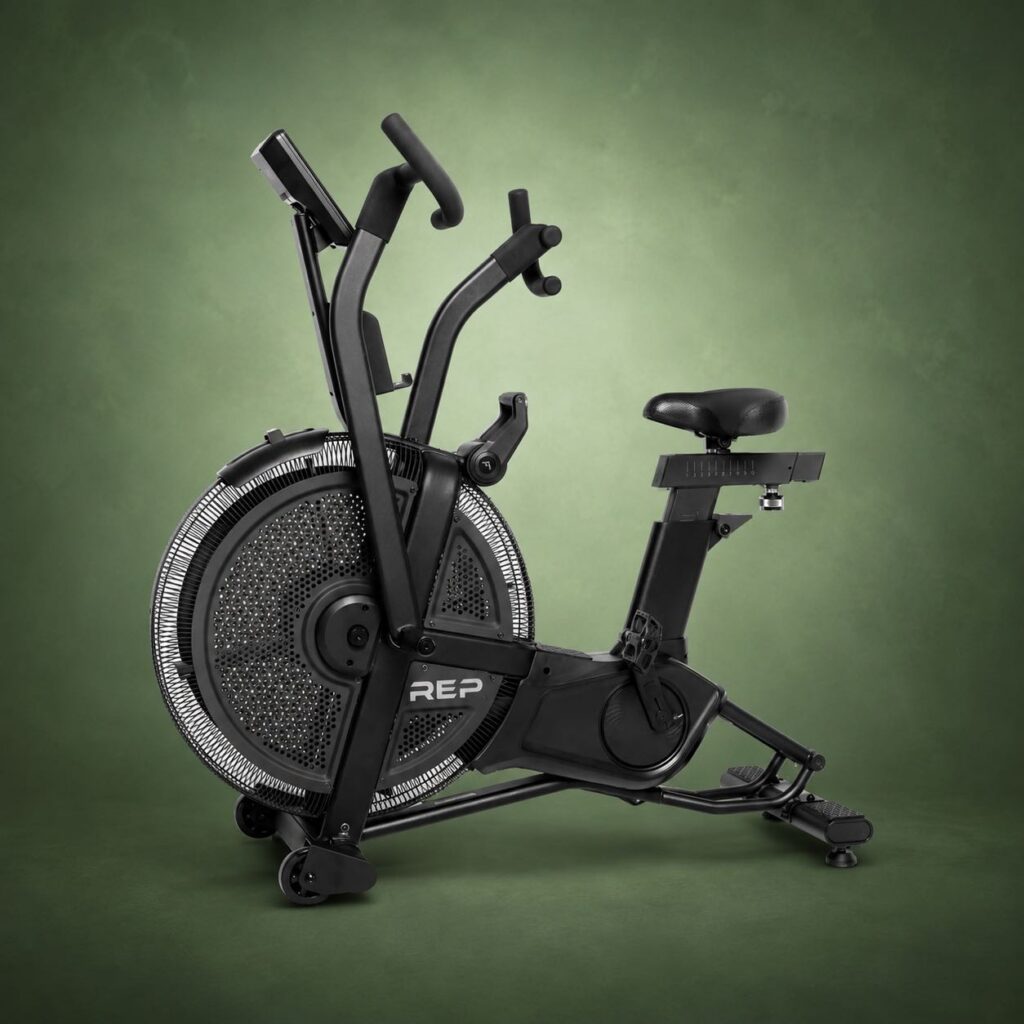
With the introduction of the REP Fitness Strive Air Bike featuring Variable Pitch Resistance (VPR) technology, REP has taken a familiar piece of cardio equipment and added something genuinely new. Instead of relying solely on how hard you pedal to generate resistance, the Strive Air Bike allows you to mechanically adjust the pitch of the fan blades, creating multiple resistance levels and fundamentally changing how the bike feels during a workout.
After spending time researching the technology and comparing it to traditional air bikes, it’s clear that REP isn’t simply trying to build another Echo Bike competitor. They’re attempting to redefine what an air bike can do.
Specifications
- Variable Pitch Resistance (VPR) Technology
- Eight resistance levels
- Dual-stage belt drive system
- Bluetooth and ANT+ connectivity
- Backlit LCD console
- Four-way adjustable seat
- Multi-grip handlebars
- Magnetic wind guard
- Built-in phone holder
- Built-in water bottle holder
- Integrated transport wheels
- Commercial-grade steel construction
More Spec Information
- Length 57.41″ / 1458mm
- Width 27.23″ / 692mm
- Height 53.24″ / 1352mm
- Product Weight 146lbs / 66.4kg
- Maximum User Weight 350lbs / 160kg
- Handle Grip Diameter 1.375″ / 35mm
- Handle Grip Material Rubber Coated
- Frame Specifications (steel sizing / ga.) 2mm thick tube / 14 ga.
- Frame FinishSatin Metallic Powder coat
- Transport Wheels 4″ / 100mm Diameter High-Capacity Casters
- Console Type LCD
- Screen Size 3.62″ x 5.9″ / 92mm x 150mm
- Power Adapter Compatible, Not Included 9V 2A adapter
- Water Bottle Holder Included
- Phone Holder Included
- Magnetic Wind Diverter Included
Note: For heart rate monitoring, it supports devices that use ANT+, a wireless protocol that relays sensor data. For training apps, the monitor is FTMS-compatible, which means it works with most apps that support the Fitness Machine Service (FTMS) protocol over Bluetooth, allowing real-time tracking of performance metrics.
Assembly and Potential Issues
One area worth paying attention to during STRIVE Air Bike assembly is the fit of the moving arms where they attach to the bike’s spindle.
In a Reddit assembly discussion, several owners reported difficulty getting an arm to slide fully into place. One said the fit required some patience but ultimately worked, while another reported that even a replacement arm would not fit. According to that owner, REP arranged to replace the bike, although the replacement was still pending when they commented. Other owners reported assembling their bikes without this problem. reddit.com
I also ran into a bit of an assembly problem when trying to mount the arm to the spindle, but eventually got it to work. One side definitely went on easier than the other.
Check the Arm Fit and Movement
The discussion also included mixed reports about side-to-side movement in the arms. One owner noticed some play after assembly, while another reported none. These individual experiences suggest the arm connections deserve a careful check, but the thread does not establish how common either issue is. reddit.com
My recommendation is to follow REP’s current assembly instructions closely and confirm that both arms are fully seated before using the bike. If an arm will not slide into position, avoid hammering it into place or using the mounting bolts to force it on. Photograph the connection and contact REP for guidance.
Once assembled, start with a gentle test ride and check for unexpected movement, clicking, or looseness. If something feels wrong, resolve it with REP before beginning hard intervals. The STRIVE’s performance is appealing, but proper fit and secure assembly should be part of the experience from day one.
What Is Variable Pitch Resistance (VPR)?
The headline feature of the Strive Air Bike is REP’s Variable Pitch Resistance technology.
Traditional air bikes use fixed fan blades. The harder you pedal, the faster the fan spins and the more resistance you encounter. While effective, you’re locked into a single resistance curve.
REP’s VPR system allows users to change the angle of the fan blades using a dedicated adjustment lever. Increasing the blade pitch creates more resistance, while decreasing the pitch creates less resistance. This gives the bike eight distinct resistance levels and dramatically expands the range of training options available.
Think of it as the difference between driving a car with only one gear versus having multiple gears available. You still control the effort, but now you can select how the machine responds.
For endurance athletes, that means easier Zone 2 sessions. For CrossFit and HYROX athletes, it means the ability to create brutally difficult intervals that exceed what most traditional fan bikes can deliver.
When I first started looking into the REP Strive Air Bike, I came across another review where the reviewer suggested that Variable Pitch Resistance (VPR) was little more than a marketing gimmick. At first, I could understand the skepticism. The fitness industry is full of buzzwords and “innovations” that often amount to little more than a new paint color or a slightly different handle design. It’s easy to assume VPR falls into that category.
The more I researched the technology, however, the more I realized that VPR is actually changing one of the fundamental characteristics of how an air bike operates. Traditional fan bikes only allow you to manipulate resistance through effort—the harder you pedal, the greater the resistance becomes. VPR introduces another variable by allowing riders to physically change the pitch of the fan blades, altering the resistance curve itself. That’s not simply a cosmetic feature or a marketing term; it’s a genuine mechanical difference that affects how the bike responds during a workout.
Whether every athlete will take advantage of all eight resistance settings is another question entirely. Some users may find a setting they like and rarely move it. Others, particularly those training for specific goals such as HYROX, DEKA, CrossFit, sprint intervals, or Zone 2 endurance work, may appreciate the ability to tailor the bike’s resistance profile to the workout they’re performing. In that sense, VPR isn’t a gimmick—it’s a tool. Like any tool, its value depends on how you use it.
What ultimately changed my perspective was seeing organizations like DEKA adopt VPR-equipped bikes for competition. If Variable Pitch Resistance was simply a marketing buzzword, it’s unlikely we’d see it finding its way onto competition floors. The technology creates measurable differences in how the bike feels and performs, and whether that makes it better than a traditional air bike will come down to personal preference and training style. For me, the most compelling aspect of VPR isn’t that it makes the workout easier or harder—it’s that it gives athletes more control over how they train.
Rep Strive Air Bike Vs Rogue Echo Air Bike
The Rogue Echo Bike is the obvious comparison for the REP STRIVE Air Bike. The Echo has earned its reputation for stability, durability, and a smooth belt-driven ride. REP’s biggest advantage is different: it lets you change how much resistance the fan creates without having to pedal faster. Rogue Fitness
| Feature | REP STRIVE Air Bike | Rogue Echo Bike V3.0 |
|---|---|---|
| Resistance | Eight settings; adjustable fan blade angle | Fixed fan blades; resistance rises with speed |
| Drive | Belt driven | Belt driven |
| Bike weight | 146 lb | 123 lb |
| Listed price | $1,299.99 | $945 |
Prices are the manufacturers’ listed prices as of October 1, 2026. The optional Rogue M2 monitor costs an additional $155. Rogue Fitness
The difference you feel during a workout
On the Echo Bike, the way to make the workout harder is to push and pedal faster. That simple approach works especially well for hard intervals and short efforts. The STRIVE gives you another option. Its Variable Pitch Resistance (VPR) system changes the angle of the fan blades, so you can make the bike easier or harder while maintaining a similar cadence. REP describes settings 1–3 as suited to easier cardio, 4–6 as a more traditional air bike feel, and 7–8 as its most demanding range. Rogue Fitness
That range is what makes the STRIVE more appealing to me. Lower settings make longer steady-state sessions more approachable, while higher settings let me push against more resistance during threshold intervals, HIIT, and VO₂ max work. It also gives people with different fitness levels more ways to use the same bike. I would avoid claiming that one bike produces more watts than the other without a controlled side-by-side test; the clear, practical difference is the STRIVE’s ability to change resistance independently of speed.
Which bike makes more sense?
The Echo remains a strong choice if you want a proven, sturdy air bike primarily for conditioning and want to spend less. Its V3.0 console already includes Bluetooth and ANT+ connectivity, though Rogue sells its more advanced M2 monitor separately. The STRIVE costs about $355 more at current listed prices, but its adjustable resistance makes it the more versatile choice for a home gym where the bike will see everything from easy cardio to demanding intervals. For my training, that flexibility is the reason I would choose the STRIVE.The Rogue Echo Bike remains a benchmark for durability, stability, and smooth belt-driven performance. It delivers a great workout, but beyond an upgraded monitor, the bike itself has changed little since its release. REP took a different approach with the STRIVE Air Bike, adding features that make it feel more versatile and give riders more control over their workouts.
What makes the REP different isn’t necessarily that it’s smoother or more stable. It’s the expanded resistance range.
At lower VPR settings, the Strive can feel more approachable than a traditional air bike. At higher settings, the bike becomes significantly more demanding, allowing riders to generate higher watt outputs without requiring extreme cadence. REP claims the system allows both lower and higher wattage ranges than traditional air bikes.
For athletes who spend a lot of time performing steady-state cardio, threshold intervals, HITT, and VO2 max work, that flexibility is a major advantage.
A Better Tool for HYROX Training?
As someone who regularly trains for HYROX events, this is where the Strive Air Bike becomes particularly interesting.
While the air bike is not a competition station in HYROX, it’s one of the most effective tools available for developing cardiovascular capacity and improving recovery between high-intensity efforts.
The ability to manipulate resistance independently of cadence creates training opportunities that simply don’t exist on a standard fan bike.
For example:
- Zone 2 aerobic rides
- Sprint intervals
- VO2 max sessions
- Recovery workouts
- Strength-focused conditioning
- Mixed-modal interval training
Rather than feeling like a one-dimensional suffering machine, the Strive begins to resemble a complete conditioning platform.
For athletes balancing strength training, running, rowing, SkiErg work, and sled sessions, that versatility has real value.
Training for DEKA FIT, DEKA STRONG, and DEKA MILE
One area where the REP Fitness Strive Air Bike really shines is preparing athletes for DEKA events. Whether you’re training for DEKA FIT, DEKA STRONG, or DEKA MILE, developing the ability to generate power while managing fatigue is critical. DEKA’s Zone 7 requires athletes to complete 25 calories on an air bike before moving on to the final stations of the race, making efficient pacing and energy management incredibly important.
What’s particularly interesting is that DEKA events now utilize the STEPR Bionic Bike XL VPR™, which incorporates Variable Pitch Resistance (VPR) technology similar in concept to the VPR system found on the REP Strive Air Bike. Rather than relying solely on fan speed to create resistance, both platforms allow athletes to manipulate the resistance curve, creating more training options than traditional air bikes.
For DEKA athletes, this opens the door to more race-specific workouts. You can use lower resistance settings for longer aerobic sessions designed to build endurance for DEKA FIT and DEKA MILE, while higher resistance settings can help develop the leg strength, power output, and recovery capacity needed for repeated high-intensity efforts during DEKA STRONG. The ability to vary resistance independently of cadence allows athletes to train multiple energy systems on a single machine, making the Strive Air Bike a valuable tool for anyone looking to improve their DEKA performance. While the REP Strive isn’t the exact bike you’ll see on the competition floor, the shared VPR-style resistance concept provides a training experience that is closer to modern DEKA race conditions than a traditional fan bike.
STEPR Vs Rep Fitness Air Bike

The most obvious competitor to the REP Strive Air Bike is the STEPR Bionic Bike XL VPR. Both bikes feature Variable Pitch Resistance (VPR) technology, allowing users to alter resistance beyond what a traditional fixed-fan air bike can provide. However, the two companies have taken noticeably different approaches to the concept.
The first difference most buyers will notice is price. The REP Strive Air Bike currently sells for approximately $1,299 with free shipping, while the STEPR Bionic Bike XL VPR carries a retail price of around $1,999 to $2,499 depending on promotions and retailer availability. That means the STEPR can cost $700 to $1,200 more than the REP, which is a substantial difference for most home gym owners.
From a technology standpoint, both the REP Strive Air Bike and the STEPR Bionic Bike XL utilize Variable Pitch Resistance (VPR) technology and both rely on a manual adjustment lever that allows users to change the pitch of the fan blades. This gives athletes the ability to modify the bike’s resistance profile rather than relying solely on effort and fan speed, as is the case with traditional air bikes like the Rogue Echo Bike or AssaultBike.
Where the two bikes begin to differ is not necessarily in the VPR concept itself, but in how they are positioned within the market. The REP Strive offers an adjustable resistance scale with numbered reference points while allowing riders to make adjustments between those positions. Similarly, the STEPR Bionic Bike XL uses a manual VPR lever to fine-tune resistance levels based on the athlete’s training goals. In practice, both bikes provide significantly more resistance customization than traditional fixed-fan air bikes.
The biggest distinction may actually be outside of the hardware itself. STEPR currently has a strong connection to the DEKA ecosystem and serves as the official air bike used in DEKA FIT, DEKA STRONG, and DEKA MILE competitions. For athletes who regularly compete in DEKA events, training on the same platform used on race day can be a meaningful advantage. REP, on the other hand, offers a more affordable entry point into VPR technology while still delivering many of the same training benefits that make variable resistance air bikes appealing in the first place.
For most home gym owners, the decision will likely come down to budget and training goals. If your primary objective is to replicate the exact experience you’ll encounter during a DEKA race, the STEPR Bionic Bike XL may be worth the premium. If you’re looking for a versatile air bike with VPR technology at a substantially lower price point, the REP Strive presents a compelling value proposition.
Where STEPR currently has a significant advantage is in the DEKA ecosystem. In 2026, the STEPR Bionic Bike XL VPR became the official air bike of the Spartan DEKA Series. This means athletes competing in DEKA FIT, DEKA STRONG, and DEKA MILE will encounter the STEPR at every Zone 7 station worldwide. For serious DEKA competitors looking to replicate race conditions as closely as possible, that alone may justify the additional investment.
That said, the REP Strive Air Bike offers tremendous value. At nearly half the price in some cases, it delivers many of the same benefits that make VPR technology appealing in the first place. Athletes can train at lower resistance settings for endurance work, increase resistance for power intervals, and enjoy a broader training range than a traditional Echo Bike or AssaultBike can provide. For many garage gym owners, the REP will likely represent the better value proposition.
If your primary goal is preparing for DEKA races and training on the exact platform used in competition, the STEPR Bionic Bike XL VPR has a clear advantage. If you’re looking for a versatile, innovative air bike with VPR technology at a significantly lower price point, the REP Strive Air Bike is extremely compelling and may offer the better overall value for most athletes.
Build Quality and Design
REP clearly spent significant time refining the design before bringing the bike to market.
The frame uses heavy-duty steel construction designed for both commercial and home gym environments. The bike utilizes a dual-stage belt drive system rather than a chain, resulting in quieter operation and reduced maintenance requirements.
Several details stand out:
Narrower Q-Factor
One feature that doesn’t receive enough attention is the bike’s 8.4-inch Q-factor.
Q-factor refers to the distance between the pedals. Many air bikes feel wider than traditional cycling setups, which can create an awkward pedaling motion. REP intentionally narrowed the stance to create a more natural riding position.
Multi-Grip Handlebars
The handlebars offer multiple hand positions, allowing users to change grip styles during longer rides or intervals. This may seem minor, but anyone who has spent 30 minutes on an air bike understands how valuable small comfort improvements can be.
Magnetic Wind Guard
The magnetic wind guard is another thoughtful feature.
Traditional air bikes often blast riders with airflow. While that feels great during summer workouts, it can be less enjoyable during winter training. REP’s magnetic wind guard can be quickly attached or removed without tools.
Console and Connectivity
The Strive Air Bike includes a backlit LCD console capable of tracking:
- Time
- Distance
- Calories
- RPM
- Watts
- Heart rate data
Bluetooth and ANT+ compatibility allow the bike to connect with heart rate monitors and training apps. For athletes who follow structured conditioning programs, watt tracking can be especially valuable for measuring progress and maintaining target intensity zones.
While it doesn’t feature a large touchscreen like some premium cardio machines, the included console appears focused on functionality rather than unnecessary complexity.
What I Like
VPR Is a Legitimate Innovation
Many fitness products launch with flashy marketing claims but offer little meaningful improvement.
VPR appears different.
Changing the fan blade pitch fundamentally alters how the bike performs and opens new training possibilities unavailable on standard air bikes.
Built for Multiple Training Styles
The bike isn’t limited to HIIT workouts.
Whether your goal is endurance, recovery, aerobic base building, sprint intervals, or conditioning for competition, the Strive can adapt.
Excellent Attention to Detail
The magnetic wind guard, phone holder, water bottle holder, narrow Q-factor, knurled adjustment points, and multi-grip handles demonstrate that REP spent considerable time refining the user experience.
What I Don’t Like
Premium Pricing
The biggest drawback is price.
At approximately $1,299, the Strive Air Bike enters premium territory. That’s significantly more than many air bikes and places it directly against established competitors like the Rogue Echo Bike.
New Technology Means Limited Long-Term Data
While VPR looks promising, it hasn’t been on the market long enough to build the decades-long reputation enjoyed by some competing products.
That doesn’t mean reliability will be an issue, but it does mean early adopters are helping establish that track record.
Variable Pitch Resistance
While the VPR lever allows users to manually adjust the pitch of the fan blades and fine-tune resistance, one limitation is the lack of precise feedback between the numbered settings. For example, if you move the lever from Level 2 toward Level 3—or back down toward Level 1—there’s no clear indicator showing exactly where you are within that range. You know you’ve increased or decreased resistance, but it’s difficult to consistently return to the exact same position for future workouts.
For athletes who follow structured training programs or want to replicate specific workout conditions, this can make repeatability a bit more challenging. While the numbered settings provide useful reference points, the resistance adjustments between those markers are essentially estimated rather than measured. It’s not a major issue during casual training, but it’s something detail-oriented athletes may notice when trying to precisely track progress or recreate previous sessions.
I feel this might be the biggest oversight for the Strive Air Bike. Knowing that say you are in position 2.5 or 2.75 would be welcome.
Final Verdict
The REP Fitness Strive Air Bike featuring VPR technology may be the most innovative air bike released in years.
Rather than simply copying what already exists, REP identified one of the biggest limitations of traditional air bikes and developed a solution that expands both the resistance range and training versatility of the machine. The result is an air bike that can handle everything from recovery rides and Zone 2 cardio to brutal sprint intervals and high-output conditioning sessions.
If you’re looking for the cheapest air bike available, this isn’t it.
If you’re looking for a proven machine with a decade-long track record, the Rogue Echo Bike still deserves consideration.
But if you want the most technologically advanced air bike currently available, one that genuinely brings something new to the category, the REP Fitness Strive Air Bike with VPR technology may very well be the future of fan-bike training.