



REP Fitness Nighthawk Adjustable Bench Review: A Worthy Replacement for the AB-4100?
REP Fitness has built one of the strongest adjustable bench lineups in the home gym industry, so replacing one of its most popular models was always going to be a challenge. The REP Fitness Nighthawk Adjustable Bench is essentially the next generation of the AB-4100, but calling it simply an updated AB-4100 probably undersells it. REP kept the compact footprint and maneuverability that helped make the AB-4100 popular while improving the padding, stability, attachment compatibility, aesthetics, and overall fit and finish.

After spending time with the Nighthawk, there is a lot I like about this bench. In fact, the padding might be one of my favorite features. It is extremely comfortable without feeling soft or unstable, and the entire bench feels much more premium than its relatively compact size might suggest. There are also a few things I would change. I would like more back-pad angles, the black-on-black angle numbers can be difficult to see, and I still wish REP had given the back pad a small amount of native decline.
Those complaints don’t change my overall impression. The Nighthawk is an exceptionally well-designed adjustable bench and arguably hits the sweet spot in REP’s lineup for someone who wants a premium bench without dealing with the size and weight of something like the BlackWing.
REP Nighthawk Pros and Cons
| ✅ Pros | ❌Cons |
|---|---|
| ✅ Excellent molded polyurethane padding | ❌ Only seven back-pad positions |
| ✅ Compact and relatively easy to maneuver | ❌ Large jumps between some incline angles |
| ✅ Very stable despite weighing only 88 lbs | ❌ No native back-pad decline |
| ✅ Excellent build quality and finish | ❌ Black-on-black angle markings can be difficult to read |
| ✅ 7-gauge main frame construction | ❌ Attachment receiver isn’t universally compatible |
| ✅ Closed ladder adjustment system | ❌ 700-lb capacity is lower than REP’s heavier premium benches |
| ✅ Vertical storage | ❌ No optional replacement rail with additional angles |
| ✅ Leg Roller 2.0 compatibility | |
| ✅ Compatible with leg developer attachments | |
| ✅ Knurled transport handle | |
| ✅ IPF-compliant 16.7-inch height | |
| ✅ Multiple color options |
REP Fitness Nighthawk Specifications
Here are the main specifications for the Nighthawk:
| Specification | REP Nighthawk |
| Bench Weight | 88 lbs |
| Length | 51″ |
| Width | 25.9″ |
| Height | 16.7″ |
| Back Pad Angles | 0°, 15°, 30°, 45°, 60°, 75°, 85° |
| Seat Pad Angles | -15°, 0°, 10°, 20° |
| Back Pad Length | 36″ |
| Back Pad Width | 11.8″ |
| Seat Pad Length | 13″ |
| Pad Gap | 1.57″ |
| Footprint | 9.2 sq. ft. |
| Weight Capacity | 700 lbs |
| Steel | 7- and 14-gauge |
| Vertical Storage | Yes |
| Current MSRP | $449.99 |
REP currently lists the Nighthawk at $449.99, with a 700-pound capacity and seven back positions ranging from flat to 85 degrees.
That 88-pound weight is important because it is one of the reasons I think the Nighthawk works so well in a home gym.
There are adjustable benches that are technically more capable, but once a bench starts weighing 120 or 130 pounds, moving it around repeatedly becomes considerably less enjoyable.
The Nighthawk gives you a lot of that premium-bench feel without turning the bench itself into part of your workout.
🔧 Build and Assembly
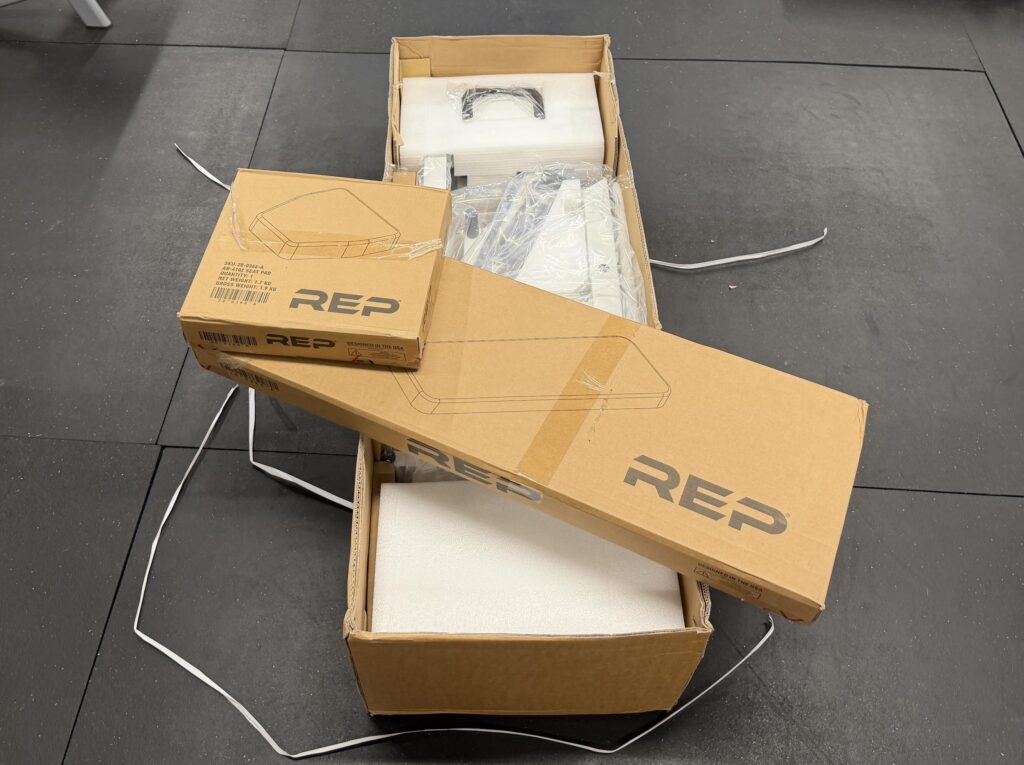
The REP Nighthawk arrived in a single box weighing around 103 pounds and was delivered via FedEx. Inside the main box, the components were packed into two additional boxes that included the seat pad and back pad. The package also included the front and rear stabilizers, assembly instructions, tools, and the necessary hex bolts.
Assembly was extremely straightforward and didn’t require much work. Most of the bench comes preassembled, so the only major steps were attaching the back pad, seat pad, front stabilizer, and rear stabilizer. Once those four components were installed, the bench was essentially ready to use.
I really appreciated how simple REP made the assembly process. There weren’t dozens of small parts or complicated steps to work through, and the included tools meant you could assemble the bench without needing to pull out a full toolbox. For a piece of equipment this substantial, the Nighthawk was one of the easier benches I’ve put together.
REP Fitness Nighthawk Specifications
The Nighthawk weighs 88 pounds and measures approximately 51 inches long, 25.9 inches wide, and 16.7 inches tall. The back pad provides seven positions at 0, 15, 30, 45, 60, 75, and 85 degrees, while the seat adjusts to -15, 0, 10, and 20 degrees. The back pad measures 36 inches long and 11.8 inches wide, with a 13-inch seat pad and a 1.57-inch pad gap. REP rates the bench for up to 700 pounds and uses a combination of 7- and 14-gauge steel throughout the construction.
That 88-pound weight is especially important because it is one of the reasons I think the Nighthawk works so well in a home gym. There are adjustable benches that are technically more capable, but once a bench starts weighing 120 or 130 pounds, moving it around repeatedly becomes considerably less enjoyable. The Nighthawk gives you a lot of that premium-bench feel without turning the bench itself into part of your workout.

The Nighthawk Replaces the REP AB-4100
One of the first things I noticed when looking through REP’s website was that the AB-4100 appeared to be missing. REP confirmed to me that the AB-4100 has been phased out and the Nighthawk is its replacement.
That relationship becomes fairly obvious when comparing the overall design philosophy of the two benches. The AB-4100 became popular because it offered a compact, relatively lightweight bench that was still stable enough for serious strength training. REP didn’t abandon that formula with the Nighthawk. Instead, it refined it. The Nighthawk gets updated padding, better attachment support, revised feet, improved stability, new aesthetics, vertical storage, and a number of smaller touches that make the bench feel like a more mature product.
For me, that’s the right approach. REP didn’t turn the AB-4100 replacement into a 130-pound monster. It preserved the characteristics that made the AB-4100 appealing in the first place while bringing the design more in line with REP’s newer equipment.
Build Quality Is Excellent
The first thing that stood out to me was simply how well the Nighthawk is put together. REP lists the bench as using a combination of 7- and 14-gauge steel, which initially left me wondering exactly where each thickness was being used. REP clarified that the main frame tube is 7-gauge steel, while various brackets and feet use 14-gauge steel.
That construction approach makes a lot of sense. Rather than building every component from unnecessarily thick steel and dramatically increasing the weight, REP appears to have placed the heavier material where it matters most. That helps explain how the Nighthawk can weigh only 88 pounds while still feeling extremely solid underneath you. This isn’t a lightweight bench in terms of construction quality. It is a premium bench that has been designed intelligently to keep the overall weight manageable.
✨ Nickel-Finished Knurled Handles
One of the smaller details that really stands out on the Nighthawk is the nickel-finished knurled handles. They look fantastic against the white frame and give the bench a much more premium appearance than you typically get from a basic rubber or plastic handle. It’s a small aesthetic touch, but it’s one of those details that helps make the Nighthawk feel like a higher-end piece of gym equipment.

The knurling isn’t just there for looks, either. The handle provides plenty of grip when lifting and maneuvering the bench, which is especially useful when you’re regularly moving it in and out of a rack or putting it into vertical storage. The knurl appears to use a volcano-style pattern, with a textured but relatively comfortable feel that gives you a secure grip without being unnecessarily aggressive.
I really like the combination of the nickel finish and knurling. It gives the Nighthawk some visual contrast while also serving a practical purpose, and it’s another example of REP paying attention to the smaller details rather than treating the transport handle as an afterthought.
The Hammer-Tone Powder Coat Looks Fantastic
Another detail I immediately noticed was the finish. The powder coat on my bench had a slightly wavy or textured appearance rather than the smoother powder coating I’ve seen on some other gym equipment. I actually really liked it, but I was curious about exactly what REP was using.
REP confirmed that it is powder coated and explained that there are several different types of powder-coat finishes. Most Nighthawk colors outside of matte, metallic, and olive use what REP described as a hammer-tone finish, which explains the slightly textured appearance.
The hammer-tone texture gives the frame an almost industrial look and also seems well suited for gym equipment because it does a good job of hiding minor imperfections that might stand out more on a completely smooth or glossy surface. More importantly, the application on my bench was exceptional. Fit and finish are areas where REP has become very good, and the Nighthawk continues that trend.
The Padding May Be My Favorite Feature
If there is one feature of the Nighthawk that surprised me the most, it might be the padding. The molded polyurethane padding feels fantastic. Padding is one of those things that can be difficult to appreciate from a specification sheet because you really need to use the bench to understand how it feels.
Too soft and you sink into the bench. Too hard and longer sessions become uncomfortable. Too slippery and you lose upper-body stability during presses. The Nighthawk manages to find an excellent balance. There is enough firmness to create a stable platform for pressing, but it also feels substantially more comfortable than a lot of traditional flat and adjustable benches I’ve used.
The pad surface also provides enough traction that I don’t feel myself sliding around when trying to establish good positioning for a press. This is one of those areas where the Nighthawk simply feels premium.
The 16.7-Inch Bench Height Is Excellent
Another specification that deserves attention is the height. The Nighthawk measures 16.7 inches from the floor to the top of the pad, which puts it at a very comfortable height for pressing.
That also has practical benefits even if you never plan on entering a powerlifting competition. A lower bench makes it easier for many lifters, particularly shorter lifters, to get their feet firmly planted on the floor. That can improve stability and leg drive during bench pressing. I’ve used taller adjustable benches where the added height becomes immediately noticeable, while the Nighthawk feels much more natural.
Seven Back-Pad Angles Are Good, But I Want More
My biggest criticism of the Nighthawk is probably the back-pad adjustment range. You get seven positions at 0, 15, 30, 45, 60, 75, and 85 degrees. Those angles will cover virtually every standard pressing and rowing exercise most people perform, so I don’t think the bench is lacking any essential position. My issue is more about the size of the jumps between some of them.
Going from 45 to 60 degrees and then from 60 to 75 degrees feels like a pretty substantial jump. I asked REP why it settled on seven stops rather than adding positions such as 52.5 and 67.5 degrees. REP explained that these angles match the previous AB-4100 and that the smaller Nighthawk frame limits how many ladder positions can practically be incorporated. REP’s larger 5000-series benches have additional frame space and therefore accommodate more adjustment positions.
That’s a reasonable engineering explanation, but I still wish there were a couple more. My ideal arrangement would probably be something closer to 0, 15, 25, 35, 45, 55, 65, 75, and 85 degrees. Even simply adding 52.5 and 67.5 degrees would make a noticeable difference. This is one of the areas where REP’s larger benches still have an advantage.
Could REP Offer an Optional Nine-Position Rail?
While examining the adjustment system, I noticed that the rail itself appears removable, which got me thinking about whether REP could eventually offer an optional rail with additional adjustment positions.
I asked REP about it, and unfortunately that’s apparently not the plan. REP told me the rail is bolted in place primarily for manufacturing and assembly purposes and so that it can be replaced if damaged. There are currently no plans to offer an alternate rail with additional angles.
I think that’s a bit of a missed opportunity. Having an optional nine-position rail could be an elegant way of giving users more flexibility without redesigning the entire bench. It certainly isn’t necessary, but I would be interested in one if REP ever decided to make it available.
The Angle Numbers Could Be Easier to Read
This is a relatively small criticism, but one worth mentioning. The adjustment angles are marked directly along the ladder rail, and the problem is that you’re essentially dealing with black markings against a black background. Depending on your gym lighting and the angle you’re looking from, those numbers can blend into the rail.
They aren’t impossible to see, but they’re unnecessarily difficult to read. A contrasting white, silver, or even gray marking would make identifying positions considerably quicker. I passed that feedback along to REP, and they said they would share it with the engineering team. It’s definitely not something that would stop me from buying the bench, but it is exactly the type of small refinement I’d like to see on a future revision.
I Still Wish the Back Pad Had a Slight Decline
The Nighthawk technically gives you a decline seat position, but the back pad itself doesn’t decline below zero degrees. I would have liked to see something around -10 or -15 degrees built directly into the bench.
REP’s explanation is that benches such as the Nighthawk and BlackWing are designed to work with the company’s leg roller attachment, allowing users to create more aggressive decline positions while remaining locked into the bench. I understand that reasoning, and the attachment dramatically expands what you can do with the Nighthawk.
I still think there is value in having a slight decline built directly into the back pad, though. Sometimes you don’t need an aggressive decline. Sometimes you just want the pad at -10 degrees for a certain movement. Being able to make that adjustment without installing another attachment would make the bench that much more versatile.
Closed Ladder Adjustment System
I generally like ladder-style benches because they’re fast and intuitive. Grab the back pad, lift it, move it to the position you want, and you’re ready to train. The Nighthawk uses a closed ladder design, meaning the adjustment post can’t simply lift completely out of the ladder.
That provides a couple of advantages. It makes adjustments feel more controlled, and it also keeps the back pad from swinging freely when moving or vertically storing the bench. The action is smooth and the adjustment hardware feels substantial.
REP has also placed protective plastic where the metal adjustment components contact the rail. I specifically asked whether those liners were UHMW. REP told me they use a harder plastic but couldn’t confirm the exact material. Regardless of the specific polymer, its purpose is obvious: reduce metal-on-metal contact and limit wear on the adjustment rail over time.
Attachment Receiver Size and Freak Athlete Compatibility
One of the more interesting details I noticed was the size of the attachment receiver. It looked smaller than the receiver used on the Freak Athlete bench, which made me curious about whether attachments could be interchanged between the two systems.
REP told me the Nighthawk’s tube opening is approximately 44 mm x 44 mm, with REP attachments designed specifically around that opening. More importantly, REP confirmed that the pop-pin locations and pin diameter are also different, meaning Freak Athlete attachments won’t simply slide into the Nighthawk and work.
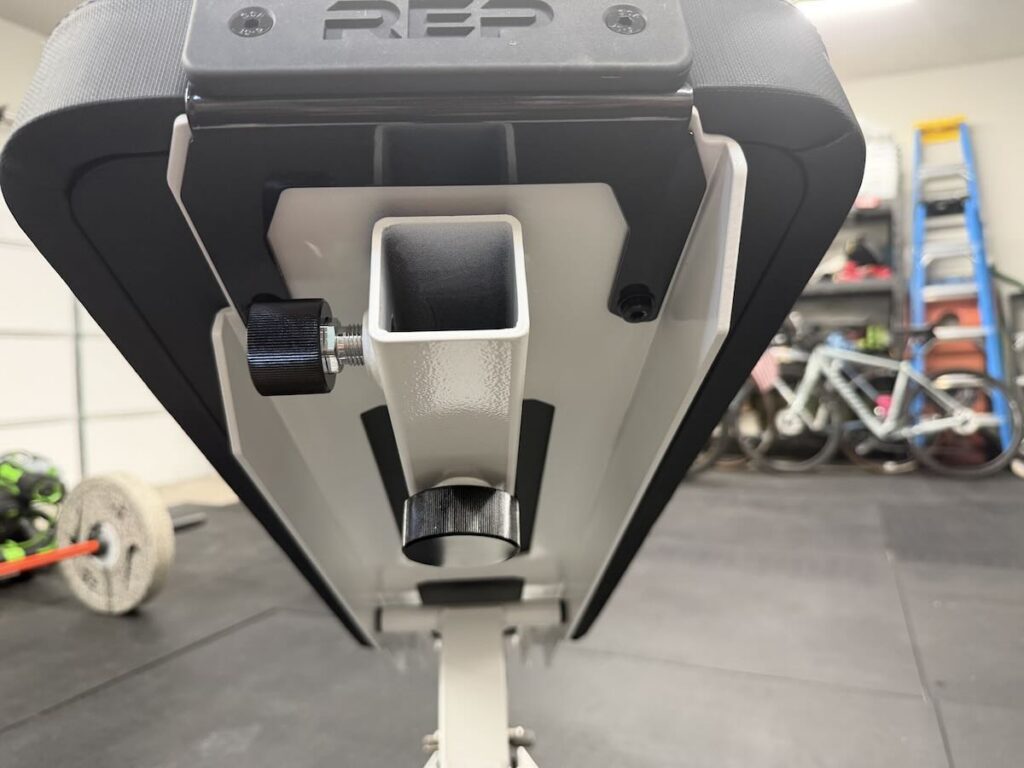
This isn’t necessarily a negative because REP is clearly building its own bench attachment ecosystem, but it is something consumers should understand. These bench receivers aren’t standardized in the same way that certain rack tubing dimensions have become standardized. Owning an attachment for one manufacturer’s bench doesn’t necessarily mean it will work with another manufacturer’s system.
I would actually like to see REP publish the receiver and attachment dimensions more prominently on the product page. As modular bench attachments continue to become more popular, those specifications are going to matter more to buyers.
REP’s Bench Attachment Ecosystem Is Becoming a Big Deal
One of the most interesting things about the Nighthawk is that REP increasingly appears to be treating the bench as more than just a bench. The receiver system creates a platform for adding accessories, and that potentially increases the value of the Nighthawk considerably over time.
The Adjustable Bench Leg Roller Attachment 2.0 can be used to secure your legs during decline presses, decline sit-ups, Nordic hamstring curls, and other exercises. REP has also developed leg developer solutions that add leg extensions and hamstring curls to compatible benches, including options involving REP’s own equipment and its collaboration with Dialed Motion.
This is where the Nighthawk starts becoming particularly interesting for smaller home gyms. Instead of dedicating floor space to several separate machines, the bench can potentially serve as the foundation for a much broader range of exercises. I wouldn’t buy the Nighthawk solely because of future attachments, but I definitely think the expanding ecosystem adds value to the platform.
The Nighthawk Is Surprisingly Easy to Move
One of my favorite characteristics of the Nighthawk is how easy it is to move. At 88 pounds, it isn’t exactly light, but weight distribution makes a huge difference. The front of the bench incorporates a knurled handle, while the large wheels at the rear allow you to roll it around the gym without much effort.
That matters much more than people realize. If you have a huge dedicated gym and your bench never moves, bench weight isn’t particularly important. In a garage or home gym, you’re probably moving the bench constantly. You might pull it into a rack for bench pressing, move it over to a functional trainer for cable work, move it again for dumbbell training, and then stand it vertically when you’re finished.
Doing that with an 88-pound bench is considerably nicer than doing it with a 120- or 130-pound bench. This is one of the main reasons I think the Nighthawk may actually be a better home-gym bench for a lot of people than some of REP’s larger models.
Vertical Storage Is a Must-Have for Home Gyms
The Nighthawk can also be stored vertically, and this is another feature that sounds relatively minor until you’re actually dealing with limited gym space. A bench consumes a surprising amount of floor space, especially when you’re trying to perform deadlifts, lunges, sled work, or other exercises that require an open area.
Being able to stand the Nighthawk vertically against a wall makes the gym feel considerably larger when the bench isn’t being used. REP also designed the bench with a dedicated vertical storage point so that you’re not simply balancing it on the upholstery. At this point, I would have a hard time buying another premium adjustable bench for my home gym that didn’t offer vertical storage.
Nighthawk vs. BlackWing
If you’re shopping REP benches, the obvious question is whether you should spend more money and buy the BlackWing instead. The BlackWing is unquestionably the more capable bench on paper. It gives you more back-pad positions, more seat adjustments, native decline capability, REP’s ZeroGap system, and a significantly higher weight capacity.
The tradeoff is size and weight. The Nighthawk weighs 88 pounds, while the BlackWing comes in at around 131 pounds. That’s a difference of more than 40 pounds, and you’re going to notice it every time you move the bench.
For a commercial gym, or someone who wants the most adjustable bench possible and rarely moves it, the BlackWing makes a very strong argument. For a home gym where you’re constantly repositioning equipment, I actually think the Nighthawk’s smaller size and lower weight may make it the better bench. Sometimes more capability on paper doesn’t necessarily translate into a better day-to-day ownership experience.
Who Should Buy the REP Nighthawk?
I think the Nighthawk makes the most sense for someone who wants a premium adjustable bench but still prioritizes maneuverability and space efficiency. It is particularly well suited for garage gyms and home gyms where the bench needs to move in and out of a rack, functional trainer, or open workout space regularly.
If you value excellent padding, vertical storage, ladder-style adjustments, strong construction, and access to REP’s growing attachment ecosystem, the Nighthawk checks a lot of boxes. On the other hand, if you absolutely need a built-in decline, frequently use intermediate angles such as 52.5 or 67.5 degrees, want a 1,000-pound capacity, or simply want the maximum possible adjustability regardless of bench weight, something like the BlackWing may make more sense.
What I Would Change
The fact that my complaints are fairly specific probably says something about how good the Nighthawk is. I don’t think REP needs to fundamentally redesign the bench. I would simply refine a few areas.
First, I’d make the angle numbers easier to see by using a contrasting color instead of black-on-black markings. Second, I would add two additional back-pad positions somewhere around 52.5 and 67.5 degrees to fill the largest gaps in the current range. Third, I’d give the back pad a small native decline, even if it was only around -10 degrees. The leg roller is great for more aggressive decline training, but a slight decline shouldn’t necessarily require an attachment.
Finally, I’d publish the attachment receiver dimensions directly in the technical specifications. REP told me the opening is approximately 44 mm x 44 mm, and with the company continuing to expand its attachment ecosystem, that is exactly the type of information consumers are going to want before buying accessories.
Final Verdict: Is the REP Nighthawk Worth It?
I think REP faced a difficult challenge with the Nighthawk because the AB-4100 was popular precisely because it wasn’t enormous. Trying to turn its replacement into the biggest, heaviest, most adjustable bench possible would have defeated the purpose.
Instead, REP kept the same basic philosophy while improving nearly everything around it. The Nighthawk is compact, easy to move, extremely stable, and exceptionally comfortable. The construction and powder coat are excellent, the closed ladder system works well, vertical storage is convenient, and REP’s expanding attachment ecosystem dramatically increases what you can potentially do with the bench.
Would I like more adjustment angles? Definitely. Would I like a small built-in decline? Yes. Would I like the adjustment numbers to be easier to read? Absolutely. But none of those issues outweigh what REP got right.
The Nighthawk sits in an interesting position within REP’s lineup. It gives you a much more premium experience than an entry-level adjustable benches while remaining substantially smaller and lighter than the company’s flagship options. For many home gyms, I think that’s exactly where an adjustable bench should be.
If you want maximum adjustability and don’t care about weight, the BlackWing may be the better choice. If you want a premium adjustable bench that’s compact, stable, attachment-ready, comfortable, and easy to live with every day, I think the Nighthawk is one of REP’s best options.
For me, that’s what makes the Nighthawk such an impressive replacement for the AB-4100.